South:
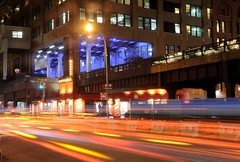
Bridging the street here is a disused elevated railroad that was used to transport
freight along the Westside waterfront, replacing the street-level tracks at 10th and 11th avenues that earned those roads the nickname "Death Avenue." Built in 1929 at a cost of $150 million
(more than $2 billion in today's dollars), it originally
stretched from 35th Street to St. John's Park Terminal,
now the Holland Tunnel rotary.
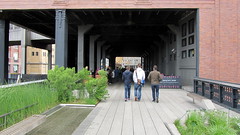
Partially torn down in
1960 and abandoned in 1980, it now stretches from Gansevoort almost
to 34th--mostly running mid-block, so built to avoid
dominating an avenue with an
elevated platform. In its abandonment, the High Line
became something of a natural wonder, overgrown with
weeds and even trees, accessible only to those who risked
trespassing on CSX Railroad property.
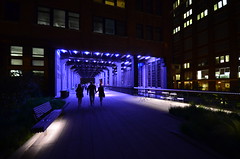
In 2009 it was
opened to the public as New York City's newest park; it truly
transforms its neighborhood and hence the city, though
it lost some of the World Without Us quality that
was its original appeal.
This stretch of the High Line is enclosed, running through the...
Chelsea Market
Former Nabisco bakeries (where Oreos
were invented in 1912) is now a
gourmet mall; features independent establishments
like Fat Witch brownies, the Green Table
organic wine bar, Hugh McMahon the Pumpkin Man,
Amy's Bread, Manhattan Fruit Exchange,
Buonitalia and much more.
Major League Baseball Productions is also based here; the studios of NY1,
New York's local cable news channel,
relocated here in 2002.
The tricky conversion from aging factory to
stylish mall was handled by Jeff Vandeberg.
448: Was Neptune Brewing Company,
1990s microbrewery.
|
|
|
North:
The High Line Park
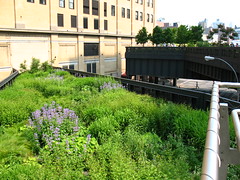
Runs along the western end of this block. There's a branch of the track, inaccessible to visitors, that more resembles the abandoned railway's original state, known as the Northern Spur Preserve.
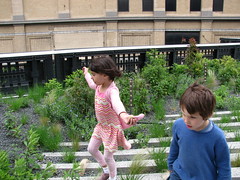
453: Was the home of the Atlantic Theater Company
Acting School, founded in 1983 on the principles of Practical Aesthetics
developed by playwright David Mamet and
actor William H. Macy, founders of the Atlantic
Theater Company. It
moved to the Port Authority Building up the street in 2006 when developers wanted to take down this building.
Highline Ballroom
431: Performance space opened in 2007. Acts like Steve Wonder, Rihanna, Lou
Reed, Adele and Amy Winehouse have played here.
|
|
South:
Port Authority Building
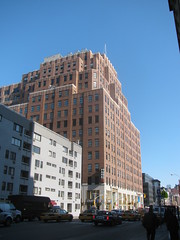
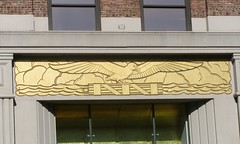
300 (block): This block-filling building,
originally known as the Union Inland Terminal No. 1,
was built by the Port Authority in 1932 to relieve
congestion by consolidating and redistributing truck
shipments. When built, it may have had more cubic
space than any building in the world—later surpassed
by the Pentagon. To make the project self-supporting,
the upper floors were designed to be rented out to
private businesses, which set a legal precedent for
 public entities engaging in commercial transactions.
It also served as the headquarters for the Port
Authority until they were moved to the World Trade
Center.
public entities engaging in commercial transactions.
It also served as the headquarters for the Port
Authority until they were moved to the World Trade
Center.
The Atlantic Theater Company
Acting School is based here, founded in 1983 on the principles of Practical Aesthetics
developed by playwright David Mamet and
actor William H. Macy, founders of the Atlantic
Theater Company. The school
moved here from down the street in 2006.

There's a Banana Republic on the ground floor. Google's
New York office occupies the entire 4th floor; it
bought the whole building in 2010.
The
Deutsch, Inc. ad agency has its headquarters here.
308: Symbolist painter
Albert Pinkham Ryder lived at this address from
1908-15.
304: This was the address of the Mike
Hammer Detective Agency in the 1957 TV show.
|
|
|
North:
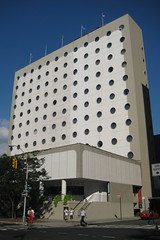
363 (corner): Built in 1966 for the
National Maritime Union, featuring porthole-like
windows and a sloping setback. Later home to
the scandal-ridden Covenant House runaway shelter. Now a
nautical-themed hotel, which includes the
acclaimed Japanese restaurant
Matsuri and the popular La Bottega.
In the post-apocalyptic novel The Dewey Decimal System, this hotel is a center for shady dealings.
357: No. 8, hard-to-get-into nightclub that's a descendant of Bungalow 8. Was XL, notable gay bar that had a "bathroom with a gay, Poseidon Adventure theme."
355: Dream Downtown
351: Think Tank
335: School of Visual Arts' Fine Arts Department
325: Chisholm Gallery, vintage posters
Corner (131 8th Ave): A Borgish-looking grey building went up at this address in 2008, wiping out almost all the other buildings and businesses on the block.
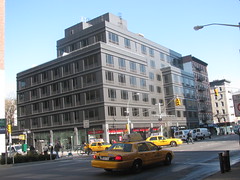 The building that used to use this address was The Bistro at Candy Bar, and earlier was the Chelsea Transfer,
a early 1980s gay bar that was ahead of the neighborhood's transformation. The corner address used to be 127 8th Avenue; Suite 16 was there, and before that Re-bar.
The building that used to use this address was The Bistro at Candy Bar, and earlier was the Chelsea Transfer,
a early 1980s gay bar that was ahead of the neighborhood's transformation. The corner address used to be 127 8th Avenue; Suite 16 was there, and before that Re-bar.
|
|
South:
Corner: Mary Ann's, Mexican mini-chain
244: Maroons, Jamaican cooking.
The Maroons were Africans in Jamaica
who had escaped from slavery.
242: Grey Dog Chelsea, coffee, was Purple Passion, fetish clothing
now on 20th Street.
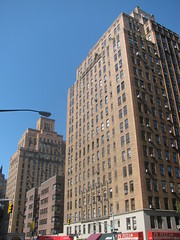
200 (corner): An orange brick building c. 1930,
part of developer Henry Mandel's
Chelsea Corners project that aimed
to create a white-collar neighborhood along 7th Avenue;
hampered by the Depression, only four of a planned
17 buildings were completed.
|
|
|
North:
245: Riazor, Spanish
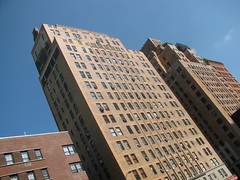
201 (corner): Another Chelsea Corners building
|
|
South:
160 (corner): Jensen Lewis
was Thomasville Home Furnishings
144-148: Italianate rowhouses built 1858.
126: French Evangelical Church was founded in 1848.
New York House and School of Industry
120: Was the headquarters of an organization that
taught needletrades (and later typing) to needy women.
In 1955, it was sold to the Friends of Hebrew Culture.
Now the Young Adults Institute, a home for people with
cognitive disabilities. This 1878 building is
considered the
first Queen Anne-style structure in the city.
114: Critic
Edmund Wilson lived here (1919-21) after getting out of the Army. During
his stay here he was a lover of Edna St. Vincent Millay and managing editor of Vanity Fair.
This was also the home of
Alexander Trachtenberg, an American Communist
who was indicted for publishing subversive books
and pamphlets; his defense committee included the likes
of Paul Robeson and W.E.B. DuBois. Apparently this
block was something of a Red neighborhood
in the 1940s and '50s.
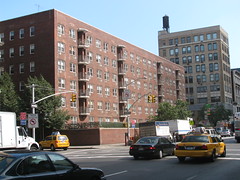
Corner (555 6th Ave): Ugly newish apartments
|
|
|
North:
Loehmann's
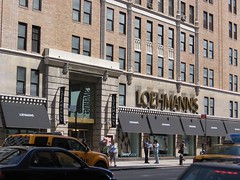
Corner (101 7th Ave): Bronx- based discounter's Chelsea outlet.
Used to be
Barney's, legendary clothing
store noted for outre window displays;
now on Madison Avenue. The building was
part of Henry Mandel's Chelsea Corners project.

Corner (575 6th Ave): Terry's Gourmet Foods. The building
is dated to 1900.
|
|
South:
Corner (570 6th Ave): Blue Valley Deli & Grocery
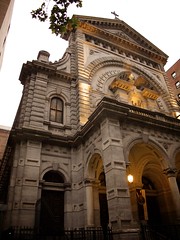
30: This imposing edifice was completed in 1882, on the site of an earlier St. Francis Xavier's built in 1850.
Founded by Father John Larkin, a Jesuit, and named for the Jesuit saint.
Father John Corridan, the
mob-fighting priest who inspired the film On the Waterfront, was associated with this church.
Xavier High School, attached to the church,
used to also be a four-year college.
 Francis Patrick Duffy, whose statue is in Times Square, taught French here from 1893-98 before he was ordained.
Archconservative Supreme Court Justice
Antonin Scalia
graduated first in the Class of 1953 here.
Francis Patrick Duffy, whose statue is in Times Square, taught French here from 1893-98 before he was ordained.
Archconservative Supreme Court Justice
Antonin Scalia
graduated first in the Class of 1953 here.
William Cullen Bryant house
24:
William Cullen Bryant, poet and editor of the New York Post,
lived here from 1867 until his death in 1878. Bryant was instrumental in
creating Central Park. Later was the home of Margaret Anderson and jane heap, editors of The
Little Review, the magazine that first published James Joyce's Ulysses, in installments from 1918-20.
Another contributor, Hart Crane, briefly lived upstairs in this building.
16: The Chelsea Lane apartments are on the former
site of New York Hospital.
4: Pure Cells New York, "cosmetic technology"
Corner (108 5th Ave): An odd
post-modern building
designed by Rothzeid, Kaiserman, Thompson & Bee
and opened in 1986.
Paul Smith, British fashion, has
"best guy shopping," according to Time Out
New York. They mean rich guys.
|
|
|
North:
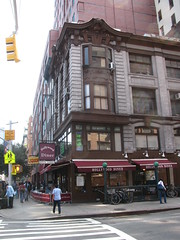
Corner (574 6th Ave): Hollywood Diner is in a fanciful 1904
building that was originally the Knickerbocker Jewelry Co.
55: The Common Ground II, Native American art
41: Joni Mitchell wrote "Chelsea Morning" here--the Clintons named their
daughter after the song.
17-23: These c. 1845 Greek Revival row houses
are NYC landmarks.
No. 17 was Margaret Sanger's Birth Control
Clinical Research Bureau.
15: The
Center for Jewish History has
in its collection the original hand-written
copy of Emma Lazarus' "The New Colossus"
("Give me your tired, your poor...").
Formerly the Helen Keller Institute was here.
5-9: More landmarked row houses from the 1840s.
In 1972, No. 5 was Beautiful Boys Unlimited, a gay
brothel that advertised, "We promise you if you come
once, you'll come again."
3: Young Israel
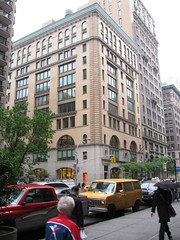
Corner (110 5th Ave): Esprit (formerly Emporio Armani)
is on the ground floor of a
striking, large-arched McKim, Mead and White building
that was built in 1888 to house
Judge, a sophisticated,
pro-Republican humor magazine founded by
ex-staffers of Puck. The building
replaced the Athenaeum Club.
|
|
South:
Corner (81 5th Ave): Was Behr Hall, a concert space
Corner (79 5th Ave): A 16-story building by Albert S. Gottlieb,
completed 1907, houses Coach, Artistic Tile, etc.
Built on
the site of Mayor
George Opdyke's house; draft rioters tried to
burn it down twice in 1863.
6: The Vera List Center for Art and Politics, a branch of The New School.
10: Chat 'N Chew, faux diner
16: Sidney Hillman Health Center was designed by R.H. Robertson in 1890 as the YWCA's
Margaret Louisa Home, paid for by Cornelius Vanderbilt's eldest daughter.
Sidney Hillman was president
of the garment workers' union (1914-46), a founder of the CIO and an important political ally of FDR.
Upstairs is the
New York City Free Clinic, run by NYU.
In the 1980s, this was Espace, which appears in the film American Psycho: "I'm on the verge of tears by the time we arrive at Espace since I'm positive we won't have a decent table, but we do, and relief washes over me in an awesome wave."
18: Breads Bakery was Sound by Singer, high-end audio. In 1872, this was the address of the
Allemania Club. The Apprentices' Library,
run by the General Society of Mechanics and Tradesmen, moved here in 1878.
20: Cafe Manna was University Market Place
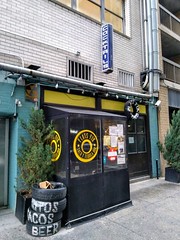
28: Flats Fix, a tacos-and-tequila joint where Alexandria Ocasio-Cortez worked before
becoming the youngest woman ever elected to Congress.
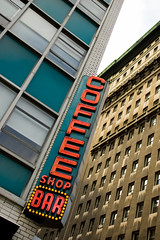
Corner (29 Union Square West): Was Union Square Coffee
Shop, retro fashion model hangout. Popular with the
Sex and the City group. Closed in 2018.
|
|
|
North:
Corner (85 5th Ave): Anthropologie, women's fashions; was B. Shackman Favors & Novelties. On site of the home (1886-88) of
Levi Parson Morton, a congressmember and governor who became vice president under Benjamin Harrison.
9-11: The 1896 building that houses Steak Frites is described by the AIA Guide as
"terra cotta candy cane."
21: Was Danny Meyer's Union Square Cafe, the most
popular restaurant in New York, according to Zagat, from 1997-2002. Moved
to 19th Street in 2017.
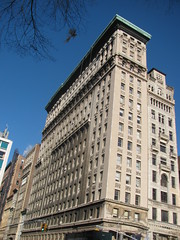
Corner (31 Union Square West): Was Blue Water Grill,
noted for seafood, also featured on Sex and the City. Closed in 2019.
The building was Bank of the
Manhattan Company; later a Parsons School of Design dorm. On
September 15, 1984, Michael Stewart was beaten to death in front of
this building by the NYPD for the crime of writing with magic marker
on a subway wall. The cops were all acquitted.
|
|
Union Square Park
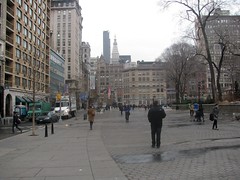
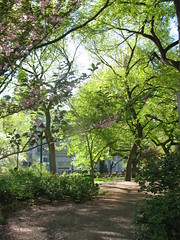
Union Square was not named for the North or for labor, but for
the fact that Broadway here meets and briefly converges with the Bowery
(now 4th Avenue), once Broadway's rival as NYC's main street. In the
city plan of 1811, Broadway was supposed to be eliminated north of
14th Street, permanently uniting it with Fourth Avenue. Fortunately,
NYC was unable to raise money to reroute Broadway, saving Manhattan
above Downtown from complete predictability.
Union Square has a rich political history: 250,000 gathered to
support Union during Civil War (1861), largest crowd ever assembled
in North America up to that point. Here was the first U.S. labor day
parade (September 5, 1882); Emma Goldman's arrest for telling unemployed to steal
bread (1893); funeral march for Triangle Shirtwaist Fire victims
(1911); protests against Sacco & Vanzetti's execution (1927) and
the Rosenbergs' (1953). After the destruction of the World Trade
Center, Union Square became the site of an impromptu memorial and
peace vigil.
Independence Flagstaff
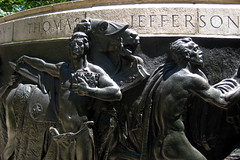
The flagpole in the center of the square, with a base
by Anthony de Francisi and a quote from Jefferson
about how we don't know how good we have it.
Francisi's bas reliefs depict the subversion
of democracy by empire; they're really quite radical.
(Officially the flagpole is dedicated to Tammany Hall
leader Charles F. Murphy, but public sentiment
dissuaded the city from elevating the machine boss
to the level of Lincoln and Washington.)
Statue of Lafayette
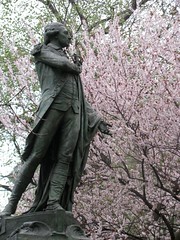
By Bartholdi, sculptor of the Statue of Liberty; he made this statue to remind New York of
Franco-American friendship as part of his campaign to raise money for Liberty's pedestal. It seems like it ought
to be facing the park rather than Fourth Avenue--as Lafayette is depicted offering his sword to Washington, whose statue is in the opposite direction.
|
|
Pavillion
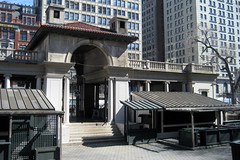
This structure dates to 1932. An outdoor restaurant, Luna Park, serves the cell-phone set here during summer months. There's been activism against "privatizing" this space, but there's been a for-profit business here for quite some time.
Statue of Lincoln
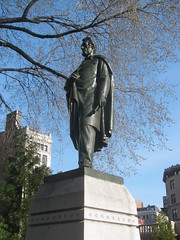
Created in 1868 just three years after Lincoln's murder, by Henry Kirke Brown, who also worked on the statue of Washington at
the south end of the park. It used to be where the Gandhi
statue is now, and it used to be surrounded by
a fence inscribed ''with malice toward none; charity toward all''
from his Second Inaugural Address. Lincoln's body
lay in state in Union Square on April 24, 1865,
before being taken to City Hall.
|
|
South:
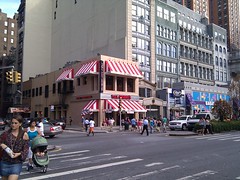
Corner: Was Zen Palate, styley vegetarian.
A friend got a serious nut-allergy reaction when eating
here once, and they tried to make us pay for his
(mostly uneaten) meal. It's since been transformed into a corporate
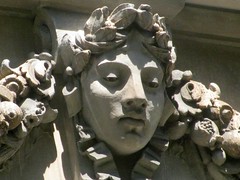
108: Oasis Day Spa; Italian Wine Merchants. Cool Dr. Moreau-like faces on
the building.
116: Candela; romantic, candle-lit
Japanese/Italian
Corner (33 Irving): Building with The Cottage, pleasant Chinese restaurant, also houses
The Nation, the oldest U.S. magazine (since 1865; at this address since 1998). Over the years its contributors have included the likes of Henry James, Leon Trotsky, H.L. Mencken, Albert Einstein, George Orwell, I.F. Stone, Jean-Paul Sartre, Martin Luther King, James Baldwin and Hunter S. Thompson.
|
|
E
A
S
T
1
6
T
H
S
T
R
E
T
|
North:
103: in the 1950s and '60s, was the
Carl Fischer Musical Instrument Co.
105: Was the address of Crown Coat Fronts,
a textile firm that in 1967 brought a
case to the U.S. Supreme Court
that involved the statute of limitations on government
contract disputes.
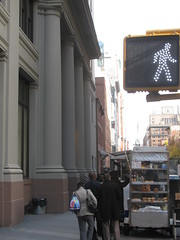
Corner: This foreboding city government building is on the site of the Westminster Hotel,
where in 1876 the Westminster Kennel Club
was formed. The club's Westminster Show has been held
continuously since 1877.
|
|
South:
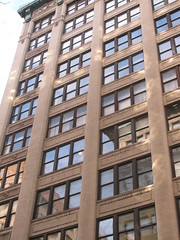
Corner (34 Irving): Spokesman Cycles, a bike shop, was
128: Painter Winslow
Homer lived here in 1859.
136: Building from 1850.
142: Gramercy Spire, apartment tower with faux Chinese lettering
Corner (162 3rd Ave): Natural Green Market, health-food store
|
|
|
North:
Washington Irving High School
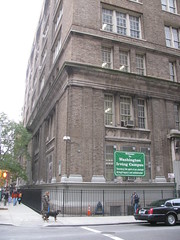
Corner: Built in 1911-13 as the Girls' Technical High School,
its students have included actors Claudette Colbert
and Whoopi Goldberg. Said to have a beautiful interior.
135: Sleepy Hollow Preschool is housed in the high school.
145 (corner): Washington Irving House, ugly white-brick apartments
|
|
South:
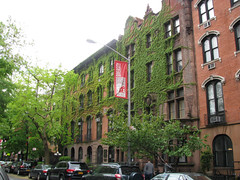
208: Fineson House
212-216: Kelley House. No. 214
was the home and studio of artist
Joseph Stella.
222: Friends Seminary is a quaker school
(K-12) founded in 1786. It's been at this location since 1860,
but the present building dates to 1963.
Friends Meetinghouse
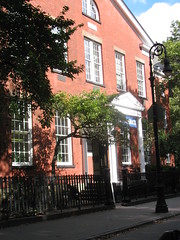
226 (corner): A beautiful brick building built
in 1860 by the Hicksites, a group of Quakers who
separated from the main congregation to pursue
more traditional forms of worship. The two groups
reconciled in 1958, resulting in the closing of
the meetinghouse on Gramercy Park (now a synagogue).
|
|
|
North:
Corner: Joe Junior, old-school hamburger joint
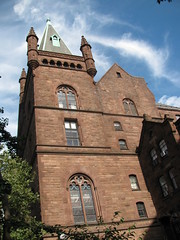
205-207: Formerly St. George Memorial House, an 1886 gift from
financier J.P. Morgan to the church. Now apartments.
209: Pierce House, St. George's parish house, described by the AIA Guide as
"a late medieval Germanic tower."
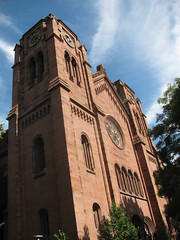 Corner: This Episcopal church, built from 1846-56, is an official
NYC landmark for its notable Early Romanesque Revival architecture. Once
one of the wealthiest congregations in the country, with J.P. Morgan as
a notable parishioner. Harry Burleigh, a soloist in the choir here for 52 years,
helped win academic respect for African-American music
through his friendship with Antonin Dvorak. Kay Leiland
Strong is married here in the novel The Group.
Corner: This Episcopal church, built from 1846-56, is an official
NYC landmark for its notable Early Romanesque Revival architecture. Once
one of the wealthiest congregations in the country, with J.P. Morgan as
a notable parishioner. Harry Burleigh, a soloist in the choir here for 52 years,
helped win academic respect for African-American music
through his friendship with Antonin Dvorak. Kay Leiland
Strong is married here in the novel The Group.
|
|
Stuyvesant Square
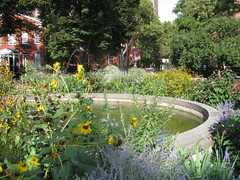
The land for this park was donated to St. George's
Church by Peter G. Stuyvesant,
 a descendant of the Dutch
colonial governor, and turned into an English-style
park in 1836. Somehow it's failed to become the kind of vibrant public
space represented by
Union,
Tompkins, Washington or even
Madison squares;
perhaps it's the bisection by 2nd Avenue, or the forbidding if
historic fence. Maybe the neighborhood, dominated
by hospitals, just isn't so lively.
a descendant of the Dutch
colonial governor, and turned into an English-style
park in 1836. Somehow it's failed to become the kind of vibrant public
space represented by
Union,
Tompkins, Washington or even
Madison squares;
perhaps it's the bisection by 2nd Avenue, or the forbidding if
historic fence. Maybe the neighborhood, dominated
by hospitals, just isn't so lively.
The western half of the park features a 1936
sculpture of Governor Stuyvesant by
Gertrude Vanderbilt Whitney. Ironically,
he's facing the meeting house of the Quakers,
a denomination he persecuted in life.
There's also a rather
lethargic fountain.
|
Stuyvesant Square
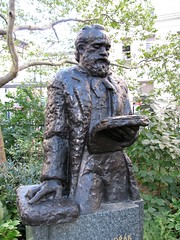
The eastern half of the park includes a dog run. It also has a statue of composer
Antonin Dvorak, which was put up in compensation when
Beth Israel tore down his nearby house on 17th Street.
|
South:
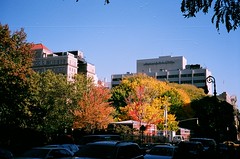
Corner: Was the New York Infirmary, a 1950 modernist statement by Skidmore, Owings and Merrill
that has not aged well. Now the Bernstein Pavilion of Beth Israel Hospital.
High School for Health Professions
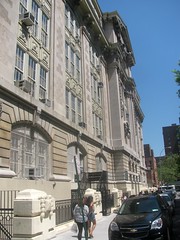
(331 E 15th): This is the back entrance to what used to be Stuyvesant High School, one of New York's
top public high schools. Founded in 1904 as a vocational school
for boys, it moved here in 1907, and to a new building near the World Trade Center in 1992. Its students have included four Nobel
laureates; writers like Lewis Mumford, Richard H. Price and
Hubert Selby; musicians like Thelonious Monk and Steely Dan's Walter
 Becker; actors including James Cagney, George Raft, Tim Robbins and
Lucy Liu, along with classic filmmaker Joseph L. Mankiewicz.
Becker; actors including James Cagney, George Raft, Tim Robbins and
Lucy Liu, along with classic filmmaker Joseph L. Mankiewicz. The political figures who come out of Stuy are a surprisingly
right-leaning lot, including Dick Morris,
Roy Innis, Thomas Sowell,
Samuel P. Huntington, Ron Silver and Albert Shanker--though
Obama adviser David Axelrod and Manhattan Rep. Jerry Nadler are
graduates too.
|
|
|
North:
Beth Israel Medical Center
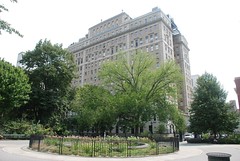
Founded in 1890 on the Lower East Side to serve Jewish immigrants, Beth Israel ("House of Israel") moved here in 1929. It incorporated the neighboring Manhattan General Hospital in 1964. It's now part of Continuum Health Partners, a nonprofit partnership that includes Roosevelt Hospital, St. Luke's and the New York Eye and Ear Infirmary. It's the university hospital for the Manhattan campus of the
Albert Einstein College of Medicine, affiliated with Yeshiva University. Yeshiva asked Einstein if they could use his name after he expressed admiration for the school's intention to "welcome students of all creeds and races."
My family has spent rather too much time in Beth Israel's emergency room.
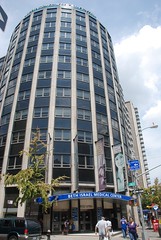
Corner (295 1st Ave): The tall building is Beth Israel's Linsky Pavilion.
|
|
Stuyvesant Town
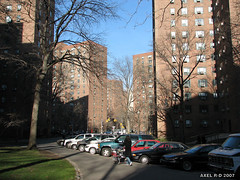
Built in the late 1940s by Met Life Insurance Co. as affordable housing for World War II vets; the private development had a great deal of public support, organized by city power broker Robert Moses. Eighteen city blocks containing 600 buildings were leveled for the project.
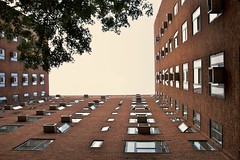
When Met Life sold it, along with Peter Cooper Village -- a total of 110 apartment buildings -- for $5.4 billion in 2006, it was reportedly the biggest real estate transaction in history...and perhaps the worst, since it was negotiated just as the housing bubble was about to pop. The purchaser was Tishman Speyer Properties, a real estate group that owned Rockefeller Center, among other things. Failing in a scheme to convert rent-stablized apartments to market rate, Tishman Speyer turned over the property to its creditors in 2010 to avoid bankruptcy.
Built on the site of the notorious Gashouse District, where fumes from chemical plants
kept out
 all but the poorest immigrants. The home turf of the Gashouse Gang,
a tough crew that specialized in robbing other gangs, since
there was so little to steal in their own neighborhood.
all but the poorest immigrants. The home turf of the Gashouse Gang,
a tough crew that specialized in robbing other gangs, since
there was so little to steal in their own neighborhood.
The development is named for Peter Stuyvesant, New Amsterdam's one-legged governor, who owned most of the land in this neighborhood. Autocratic, anti-democratic and intolerant, he was something of a 17th Century Giuliani. Earlier the mansion called Petersfield could be found here, less than one block east of 1st Avenue between 15th and 16th streets.
It was the home of Petrus Stuyvesant, a descendant of Peter.
Notable residents of Stuyvesant Town have included writers Frank McCourt, Mary Higgins Clark and David Brooks, Obama adviser David Axelrod and actor Paul Reiser.
|
|
|