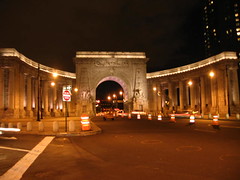
New York Songlines: 4th Avenue

including The Bowery and Park Avenue

E 59th | E 58th | E 57th | E 56th | E 55th | E 54th (Lever House) | E 53rd (Seagram Building) | E 52nd | E 51st (St. Bartholemew's) | E 50th (Waldorf-Astoria) | E 49th | E 48th | E 47th | E 46th | E 45th (Pan Am Building) (Grand Central) | E 42nd St | E 41st St | E 40th St | E 39th St | E 38th St | E 37th St | E 36th St | E 35th St | E 34th St | E 33th St | E 32nd St (Park Avenue South) | E 31st St | E 30th St | E 29th St | E 28th | E 27th (New York Life) | E 26th | E 25th | E 24th (Met Life) | E 23th | E 22nd | E 21st | E 20th | E 19th | E 18th | E 17th (Union Square) | E 16th | E 15th | E 14th | E 13th | E 12nd | E 11st | E 10th | E 9th | E 8th/Astor Place (Cooper Union) | E 7th | E 6th | E 5th | E 4th (The Bowery) | E 3th | E 2nd | Bleecker (CBGB's) | E 1st | E Houston | Stanton (New Museum) | Prince | Rivington | Spring | Delancey | Broome | Grand | Hester | Canal (Manhattan Bridge) | Bayard | Pell | Doyers (Chatham Square)
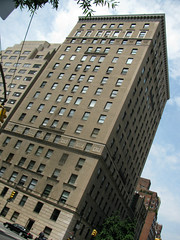
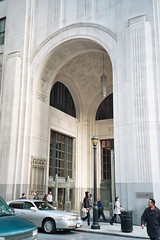
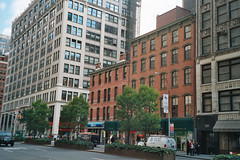

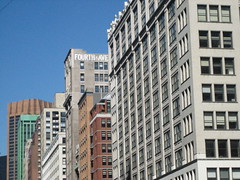
The Bowery was originally the road to Peter Stuyvesant's farm; "farm" is bouwerij in Dutch. The avenue above Cooper Square was renamed Fourth Avenue to try to shake some of The Bowery's gritty associations--but 4th Avenue became associated with a smoke-belching railroad that ran down a cut in the middle, as well as with a criminal gang that lived in the cut. When the cut was paved over, the part above 32nd Street was renamed Park Avenue, after the new surface's landscaping. The section from Union Square to 32nd was later renamed Park Avenue South to placate residents with status envy.


West:

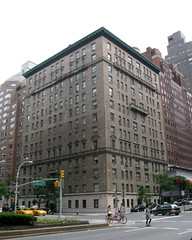
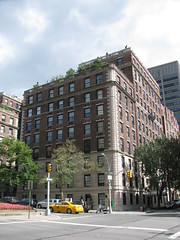
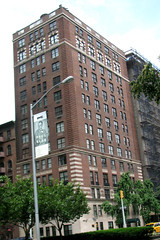
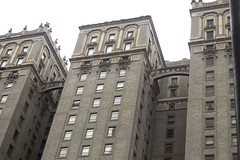
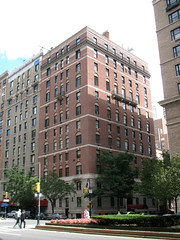
510 (corner): An attractive, 15-story brick-and-limestone apartment building, put up in 1925 as a cooperative by Starrett Brothers to a F. H. Dewey design. Philip Barry, who wrote The Philadelphia Story, moved here in 1948 and died of a heart attack here the following year.


Hotel Delmonico

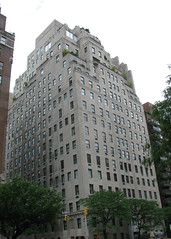
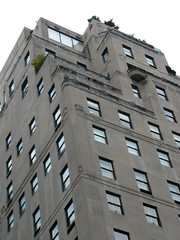
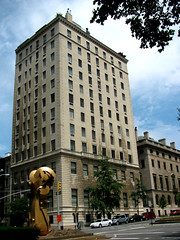
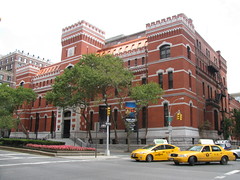
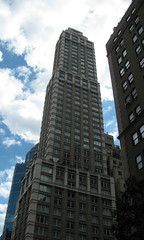
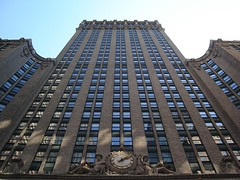
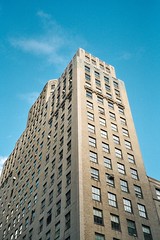
502 (corner): This 32-story building with a distinctive red-tile roof traditionally marks the boundary between the commercial Park Avenue to the south and the high-end residential to the north. It was built in 1928 as the Viceroy Hotel; in 1929, the fabled restaurant Delmonico's moved in, meriting a name change. Lyricist Lorenz Hart lived here in 1943, the year he died; TV host Ed Sullivan was a resident from 1944 until his death in 1973. In the 1970s, it was home to the auction house Christie's (which moved out in 1998) and to the ritzy disco Regine's (1976-91). Donald Trump bought the building in 2003, renamed it the Trump Park Avenue and made some dubious glassy additions.

P
A
R
K

A
V
E
N
U
E

East:

515 (corner): This 43-story highrise is the tallest residential building on Park Avenue. The tower was designed by Frank Williams & Associates and built by the Zeckendorf organization in 2000. It replaced a 1910 pallazo designed by Ernest Greene; when that building was bought by the Jewish Agency, it evicted the Syrian mission to the U.N. in favor of tenants like the World Zionist Organization.

Sherry-Lehmann

505 (corner): A venerable wine and liquor store that moved here in 2007 after nearly six decades at 679 Madison. Founded in 1934 by Jack Aaron, an ex-bootlegger who used to supply wine and spirits to the 21 Club; it was named for its original home in the Louis Sherry building. It merged in 1965 with M. Lehmann, a gourmet grocery store founded in the early 1900s. The store has introduced brands like Dom Perignon and Chivas Regal.

It's on the groud floor of the Aramco Building, built in 1948 for the Saudi Arabian state oil company and designed by Emery Roth & Co. It was given a black-and-gold makeover in 1987 by Der Scutt.

W <===     EAST 59TH STREET     ===> E

West:

Pepsi-Cola Building

PEPSI-COLA building - new york by maurizio.mwg, on Flickr

500 (corner): A modest Modernist 10-story office building with a glass-and-alumninum facade, built for the soft-drink company in 1960 to a Skidmore, Owings & Merrill design. Pepsi soon moved to suburban Westchester, and the building became home to the Olivetti Corporation, the style-conscious maker of office equipment. Now house Amro Bank as well as the Janet Sortin spa. A 40-story condo tower was added in 1980 that meshed with the original structure surprisingly well.

484: Linda Dresner, boutique Park Avenue, looking south from 59th St by Mike Roberts NYC, on Flickr

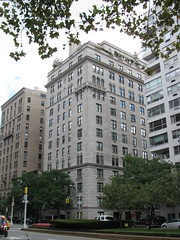
480 (corner): This 21-story apartment building, made of buff brick, limestone and terra cotta, features a gleaming marble lobby. It was put up in 1929 by developer Sam Minskoff to a blueprint by Emery Roth, who designed the penthouse apartment for himself; restauranteur Toots Shor also lived here. It replaced the Hotel Clarendon. On the ground floor are Jill Sander, boutique; James Robinson, silver.

P
A
R
K

A
V
E
N
U
E

East:

Banque de Paris Building

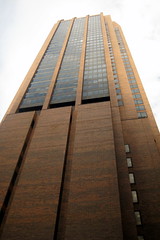
499 (corner): A 27-story black-glass tower designed by I.M. Pei, completed 1984. The elegant lobby features a painting by Jean Dubuffet. On the ground floor is Bernard Aud, housewares.


485 (corner): A 14-story limestone-and-beige-brick apartment building from 1922. On the ground floor: Pierre Marolini chocolates, Seaman Scheppe jewelry.

W <===     EAST 58TH STREET     ===> E

West:

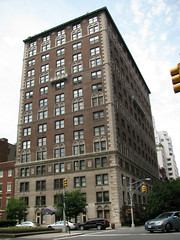
470 (corner): This 14-story red-brick apartment house was built in 1916. It was designed by Schwartz & Gross-- the farthest south of the firm's 13 buildings on Park Avenue.


460 (corner): The Consulate General of the Republic of Korea (South, that is) is in this "rather prosaic and depressing" ( City Review) 22-story office building, built in 1954 to an Emery Roth & Sons design.

P
A
R
K

A
V
E
N
U
E

East:

475 (corner): This 15-story white-brick apartment building makes a plain neighbor to the Ritz Tower. It was built in 1908 (when it was numbered 471) to a Charles W. Buckham design. Alcoa planned to build a 30-story headquarters here in the 1950s; when that fell through, the apartment building was stripped of its facades and reclad in white brick in 1958; the vandals were Charles N. and Selig Whinston. Now houses Chinese Porelan antiques; Jay Kos and Atelier Aimee, women's clothing.

Ritz Tower

Ritz Tower by Rafael Chamorro, on Flickr

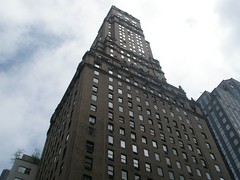
455 (corner): This 540-foot apartment hotel, designed by Emery Roth and Thomas Hastings, was a sensation when it was completed in 1926 as the city's first residential skyscraper-- "the actual arrival of the home 500 feet high," one critic marveled. William Randolph Hearst lived here with Marion Davies from 1928-38; other residents have included Greta Garbo and Paulette Goddard. The ground floor featured the celebrated French restaurant Le Pavillon; the space later became the Women's Bank of New York and is now a Borders.

W <===     EAST 57TH STREET     ===> E

West:

450 (corner): 450 Park Avenue, designed by Emery Roth & Sons and built in 1972, is "the handsomest black skyscraper in the city" (City Review). On the ground floor are Suarez purses, Tanagru jewelry.

Songwriter Jerome Kern collapsed on the sidewalk here on November 5, 1945; he died at Doctor's Hospital six days later.

444 (corner): The Drake Hotel was built on this site in 1927 and demolished 70 years later. Silent film star Lillian Gish lived here from 1946-49. Other notable guests included Muhammed Ali and Glenn Gould; restauranteur Toots Shor lived here in his final years. New York's first discotheque, Shepheard's, opened here in the early 1960s. Fauchon chocolates was on the ground floor.

P
A
R
K

A
V
E
N
U
E

East:

Universal Pictures Building

445 (block): A 1947 building by Kahn & Jacobs is considered the first "wedding cake" building--reducing its cross-section with setbacks as it goes up, in precise accordance with the zoning law. Houses Daralamb, women's clothing; Citishoes; Nelson & Nelson Silver; and T. Anthony purses.


W <===     EAST 56TH STREET     ===> E

In one of the city's worst train accidents, one steam locomotive plowed into another in the tunnel below this intersection on January 8, 1902, killing 15 passengers on the stationary train.

West:

Mercedes Benz Showroom

430 (block): Originally the Hoffman Auto Showroom, it was designed in 1954 by Frank Lloyd Wright--the master architect's first New York work. The circular ramp foreshadows Wright's New York masterpiece, the Guggenheim museum.


P
A
R
K

A
V
E

East:

425 (block): A 32-story building from 1957, designed by Kahn & Jacobs. Singer Tony Bennett has lived in this building. On this corner was formerly 103 E. 55th Street, where author John O'Hara lived in 1935 when he started writing Butterfield 8.


W <===     EAST 55TH STREET     ===> E

West:

ogling the cars by j o s h, on Flickr -->

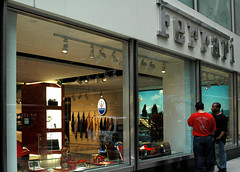
410 (block): The General Reinsurance Building was the NFL's national headquarters from 1968 until 1996, when they moved down the street. On the ground floor are Ferrari cars, and Papyrus Paper.

P
A
R
K

A
V
E

East:

417 (corner): This 13-story limestone building, put up in 1916 by Bing & Bing to an Emery Roth design, "is the last survivor of at least thirteen luxury apartment houses, most of them built before World War I," on this stretch of Park Avenue. Features Walter Steiger, purses.

407: Stefano Ricci, men's clothing


W <===     EAST 54TH STREET     ===> E

West:

Lever House

Lever House by 12th St David, on Flickr

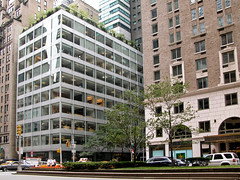
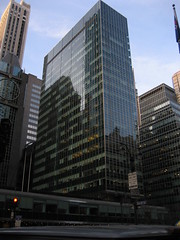
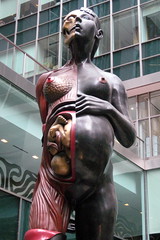
390 (block): This 21-story blue-green glass office tower, designed by Skidmore, Owings and Merrill's Gordon Bunshaft for the British soap company Lever Brothers and completed in 1952, is considered one of the most important and influential Modernist buildings in New York City. It pioneered the use of the glass curtain wall--preceded in the city only by the U.N. Secretariat Building--and the dramatic break with the street wall. NYC - Lever House: The Virgin Mother by wallyg, on Flickr

The building was landmarked in 1982--as soon as it became eligible--and was extensively restored in 1998, when an Isamu Noguchi sculpture garden was added. Since 2003, it's been home to Lever House Restaurant. The courtyard displays Damien Hirsh's disturbing Virgin Mother.

P
A
R
K

A
V
E
N
U
E

East:

Citibank Building

399 (block): This "bland, undistinguished, 39-story tower" ( City Review), designed by Carson & Lundin and Kahn & Jacobs, has been since 1961 the headquarters of Citigroup-- notwithstanding the 1978 construction of the more prominent Citicorp Center. The move here by Citibank--then known as the First National Bank of New York--sparked a trend of big banks moving from Wall Street to Midtown.


W <===     EAST 53RD STREET     ===> E

West:

Racquet & Tennis Club

NYC: Racquet and Tennis Club by wallyg, on Flickr

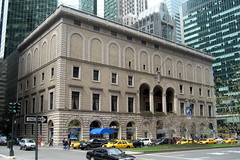
370 (block): This private men-only club, founded in 1876, is housed in an Italian Renaissance palazzo designed by McKim, Mead & White and completed in 1918. Its five-story height is designed to be twice the width of Park Avenue.


P
A
R
K

A
V
E
N
U
E

East:

Seagram Building

Seagram Building by noktulo, on Flickr

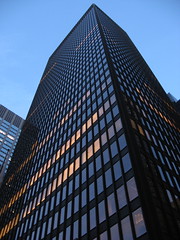
375 (block): This 39-story brown-glass-and-bronze office tower, built in 1958 for the Seagram's beverage company, is considered the epitome of the International Style and architect Ludwig Mies van der Rohe's American masterpiece. Its superbly proportioned geometric form and use of floor-to-ceiling windows were enormously influential on corporate architecture; the New York Times has called it the most important building of the 20th Century. Seagram building by jeni rodger, on Flickr

The vertical bronze beams on the exterior are, ironically, a decorative element intended to express a fuctionalist aesthetic. The plaza surrounding the building--taking Lever House's rejection of the street wall farther by eliminating the earlier building's base--was so admired that zoning laws were changed to encourage similar public spaces...few of which were as successful as this one.

The building is home to The Four Seasons, a restaurant known for its power lunches, whose sumptuous interior was designed by Philip Johnson, who was van der Rohe's collaborator on the entire structure. Painter Mark Rothko was commissioned to do art for the restaurant, but he decided he hated the place too much and kept the series for himself.

In the series That Girl, the Marlo Thomas character works in a magazine stand in this building.

The address used to be that of an apartment building on the block's northern corner, where songwriter Harold Arlen lived in the 1940s in the penthouse apartment building. Another building torn down for the skyscraper, at 116 E. 53rd, was the home of actor Montgomery Clift from 1935-43, when he was a teenager and young man.

W <===     EAST 52ND STREET     ===> E

West:

Park Avenue by _teufel, on Flickr

350 (block): This boxy 30-story tower was built in 1954 as the Manufacturers Hanover Trust Building, designed by Lever House's Gordon Bunshaft. The flagship branch of the Park Avenue Bank is located here.

P
A
R
K

A
V
E

East:

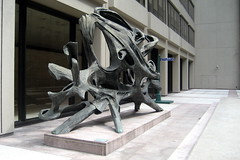
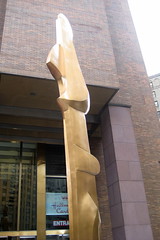
345 (block): This 44-story office tower was built in 1969 to an Emery Roth & Sons design. NYC: 345 Park Avenue - Dinoceras by wallyg, on Flickr The bronze sculpture in the plaza is Robert Cook's Dinoceras (1971)--named for an extinct rinoceros-like mammal.

W <===     EAST 51ST STREET     ===> E

West:

Park Avenue 2 by stephenarcher, on Flickr

320 (corner): Mutual of America Building, a 1950s Emery Roth building reclad in glass in the 1990s--the AIA Guide calls it a ''turgid wedding cake dressed for the Mardi Gras.''

There is (or was) a BMW Gallery--or what other companies would call a dealership--in the north corner of the building.


320 (corner): Mutual of America

P
A
R
K

A
V
E
N
U
E

East:

St. Bartholomew's Church

St. Bartholomew's Church by leesean, on Flickr

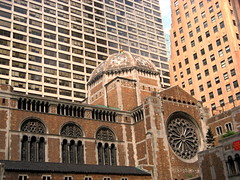
Block (109 E 50th): An Episcopalian congregation founded in 1835, ''St. Bart's'' is considered one of the more fashionable churches in town. A 1919 work by Bertram Goodhue (who considered it his favorite), its entranceway was salvaged from an earlier St. Bartholomew's designed by Stanford White. The church tried to tear down Goodhue's Community House and sell the land to developers, but the city successfully defended its landmark law in court-- an important precedent for preservationists.

Saint Bartholomew was an apostle about whom little is known; tradition holds that he was martyred by being skinned alive. I suspect that churches are named after him largely because of the St. Bartholomew's Day Massacre, an attack on Protestants in France.

W <===     EAST 50TH STREET     ===> E

West:

300 (block): The Colgate Palmolive Building was built in 1955 as the headquarters of the toothpaste and soap company. (They also make Ajax and Fab.) The building, another Emery Roth design, has been called ''a beige box with an horizontal emphasis that conveys the heaviness of a fat plantation owner sleeping and immovable on some stodgy club verandah.''


P
A
R
K

A
V
E
N
U
E

East:

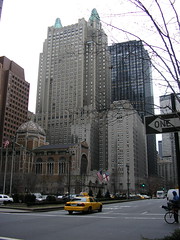
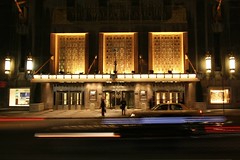
The Waldorf-Astoria

Waldorf Astoria by Rafael Chamorro, on Flickr

301 (block): One of the world's most famous hotels started out where the Empire State Building is now--formed by the merger of the Waldorf and Astoria hotels, owned by rival branches of the Astor family. (Waldorf was John Jacob Astor's German hometown.) When the skyscraper replaced the old hotel, it moved to this 625-foot Art Deco landmark (designed by Schultze & Weaver), at the time the largest hotel in the world; when it opened on September 30, 1931, the first guest to be served dinner was the king of Siam. The Waldorf-Astoria by eschipul, on Flickr

Former president Herbert Hoover lived here, as did future president JFK; other long-term residents include the Duke of Windsor, Henry Kissinger and generals Eisenhower, MacArthur and Bradley. Every sitting president since FDR has stayed here as a guest; LBJ met with Pope Paul VI here on October 4, 1965, during the first papal visit to the U.S. The first Tony Awards were presented here on April 6, 1947.

The hotel was featured in the Ginger Rogers film Weekend at the Waldorf. Its namesake salad is compared to a Berlin ballad in the song "You're the Top." The hotel's Empire Room was an early venue for Frank Sinatra and Diana Ross.

The hotel is now owned by the Hilton chain. The restaurant is called Peacock Alley, named for the corridor in the original Waldorf-Astoria where the fashionable paraded.

W <===     EAST 49TH STREET     ===> E

West:

280 (block): Bankers Trust East was designed in 1963 by Henry Dreyfuss, an industrial designer, under the auspices of Emery Roth & Sons. The result was a building consisting of one rectangular block on top of another. An addition to the west was added in 1971. Deutsche Bank has offices here, as well as the National Football League's national headquarters.


P
A
R
K

A
V
E

East:

299 (block): The Westvaco Building, a 1967 Emery Roth building, named for a West Virginian paper company. It hosts Japan's consul general.


W <===     EAST 48TH STREET     ===> E

West:

Union Carbide Building

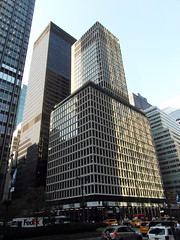
270 (block): Fifty-three stories of grey glass and matte-black steel, this 1960 Skidmore Owings & Merrill building, originally built for Union Carbide, was redone in 1983 by the same architects. The elevators start on the second floor because the building is built over a railroad yard. It now houses the world headquarters of JPMorgan Chase, the banking giant.

Corner: At this corner of Park and 47th used to be the Marguery Hotel, noted for its "quiet garden" and "famous food" in a 1936 hotel guide. NYC - Taxi by wallyg, on Flickr The Marguery in turn was said to be on the site of The Benedick, a fictional "bachelor's flat" in Edith Wharton's House of Mirth where Lawrence Selden has tea with Lily Bart.

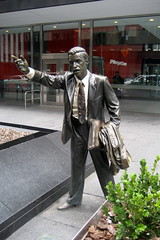
Today on this corner, J. Seward Johnson's Taxi (1983) perpetually hails a cab.

P
A
R
K

A
V
E
N
U
E

East:

277 (block): This 50-story building, a 1962 Emery Roth design, houses the investment firm Donaldson, Lufkin & Jenrette, the Continental Grain Company and Penthouse magazine. Previously on the site was the McKim, Mead & White- designed Heckscher Apartments, which housed Crillon, described in a 1940 restaurant guide as "French cuisine, smart, fairly expensive and good."


W <===     EAST 47TH STREET     ===> E

West:

250 (block): The Postum Building, named for the cereal company, is a 1925 Cross & Cross design whose smallish block (truncated by Vanderbilt Avenue) has saved it from demolition and replacement with a gigantic glass structure--so it gives some idea of the "Terminal City" which once surrounded Grand Central. Now houses the Marine Midland Trust Co.; there's an Audi dealership on the ground floor.


P
A
R
K

A
V
E

East:

245 (block): This 1967 building is by Shreve, Lamb & Harmon, better known for designing the Empire State Building. Built for the American Tobacco Company, it was the Bear Stearns investment bank's headquarters from 1987-2001. Now Xerox has offices here. Previously on the site was Warren & Wetmore's Grand Central Palace Building (1911), an exhibition hall.


W <===     EAST 46TH STREET     ===> E

New York Central Building

The Helmsley Building by Steve and Sara, on Flickr

230: The original name of this 1929 Warren & Wetmore building; when it was changed to ''New York General Building,'' only two stone-carved letters needed to be altered. Later renamed the Helmsley Building by the Queen of Mean.

It's built on shock absorbers to dampen the rumbling of Grand Central's trains; legendary tour guide Justin Ferate demonstrates that it doesn't touch the ground by slipping a ballpoint pen between the building and its foundation.

On September 10, 1931, capo de tutti capi Salvatore Maranzano was murdered in his ninth-floor office here by hitmen sent by Lucky Luciano and Vito Genovese, ambitious underlings whom Maranzano had hired Vincent ''Mad Dog'' Coll to kill.


W <===     EAST 45TH STREET     ===> E

Pan Am Building

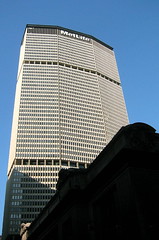
NYC: MetLife Building by wallyg, on Flickr MetLife Building from Chrysler Building by caspermoller, on Flickr

Current owner Met Life wants us to call it after them, but it'll always be the Pan Am--besides, there already is a Met Life Building, on Madison Square.

Noted for spanning Park Avenue--from the south, it can be seen from Union Square--and for the helicopter pad on the roof, no longer in use since a grisly accident in 1977 killed four passengers and a pedestrian on the ground. The rooftop was featured in the movies Coogan's Bluff and On a Clear Day You Can See Forever.


Grand Central Terminal

NYC - Grand Central Terminal by wallyg, on Flickr

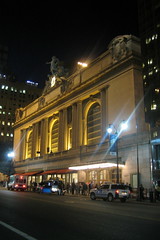
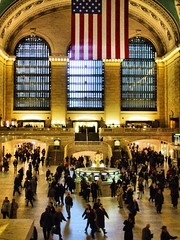
Has 67 tracks arriving at 44 platforms--more than any other train station in the world. The site became a rail terminal in 1854, when the Common Council banned steam locomotives below 42nd Street; horse-drawn trolleys took passengers the rest of the way downtown. Commodore Cornelius Vanderbilt built the Grand Central Depot here in 1871, a metal and glass structure that was reconfigured by 1900 as Grand Central Station. Between 1903 and 1913, the current Beaux Arts landmark was built, designed by Warren & Wetmore with help from Reed & Stern. Oak and acorn motifs are used throughout, a reference to Vanderbilt's motto, ''Great oaks from little acorns grow.'' Grand Central Station by KM&G-Morris, on Flickr

The terminal's Grand Concourse is noted for its ceiling constellations; they appear to be backwards, since they're based on an old-fashioned star globe that depicted the stars from the "outside." They look much better since the terminal's 1998 renovation. The staircase here was inspired by the Paris Opera.

Fred Astaire sings here in The Band Wagon. Cary Grant buys a ticket at Window 15 in North by Northwest. Terry Gilliam filmed commuters here all breaking into a waltz in The Fisher King. Lex Luthor has his lair underneath the station in the Superman movie, as do the mutants in Beneath the Planet of the Apes. Grand Central Oyster Bar by Tanguero, on Flickr

The terminal features many restaurants, including the famous Oyster Bar with its vaulted ceiling. Outside the Oyster Bar is the Whispering Gallery, an acoustical marvel that's featured in John Crowley's novel Little, Big.

The 42nd Street facade features a massive sculpture of Mercury flanked by Hercules and Minerva-- representing commerce, strength and wisdom.


W <===     EAST 42ND STREET     ===> E

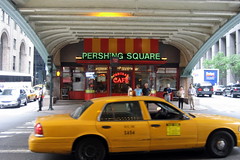
NYC - Pershing Square by wallyg, on Flickr

Part of Park Avenue rises here to allow traffic to flow around Grand Central; underneath the overpass is the Pershing Square Central Cafe.

West:

Altria by Randy Levine, on Flickr

120 (corner): Headquarters of Altria, which changed its name from Philip Morris because the old name was too associated with the selling of addictive carcinogens. The 1981 structure, designed by Ulrich Franzen, replaced the 1940 Art Deco Airlines Building. Before that it was the Belmont Hotel, the tallest building in Midtown when it opened in 1906. There's a branch of the Whitney Museum here.

P
A
R
K

A
V
E

East:

Pershing Square Building

Park Ave by van swearingen, on Flickr

Corner (100 E 42nd):

From 1914 to 1920, this area was a plaza honoring Gen. John "Black Jack" Pershing, the commander of U.S. forces in World War I. Then it was sold to a developer who put up this building, noted for its terra cotta. You can get tickets for buses to the airports here.

W <===     EAST 41ST STREET     ===> E

During subway construction here on January 27, 1902, a worker warming his hands with a candle next to 548 pounds of dynamite caused an explosion that killed five people.

West:

100 (block): Wilmer Chemists, Bistro New York are on the ground floor here.


P
A
R
K

A
V
E
N
U
E

East:

New York, NY - Midtown - 5/9/07 by Christopher & AmyCate, on Flickr

101 (block): This off-kilter black glass tower was built by Peter Kalikow in 1985, and houses his offices. A real estate developer, Kalikow now chairs the MTA and is pushing Grand Central expansion and the 2nd Avenue subway. As "Clamp Tower," the building was taken over in the movie Gremlins 2.

Built on the site of the 1912 Architects Building, where McKim, Mead and White had their offices for a time.

W <===     EAST 40TH STREET     ===> E

West:

90 (block): Sterling Drug Building (1964). This and the building across the street were both designed by Emery Roth & Sons, who also designed the World Trade Center.


P
A
R
K

A
V
E
N
U
E

East:

DSC07938.JPG by Kramchang, on Flickr

99 (block): National Distillers Building (1954). The company, which made Old Grand-Dad among other brands, was added to the Dow-Jones Industrials in 1934 to represent the newly legalized liquor industry. It was acquired by Jim Beam in 1987.

Houses Bogart's, bar that has TV monitors in the restrooms for spying on your date.

At this address was the house of Andrew Haswell Green, a city comptroller who helped establish the New York Public Library, the Metropolitan Museum, the American Museum and Central Park, along with Riverside, Morningside and Fort Washington parks. His work on the commission that consolidated the five boroughs earned him the title of "Father of Greater New York." He was shot to death on this sidewalk, November 13, 1903, by an deranged stranger.


W <===             EAST 39TH STREET             ===> E


This was the northern edge of the Murray Hill farm.

West:


70 (corner): 70 Park Avenue Hotel, formerly the Doral Park Hotel, where the French celebrity stayed in The French Connection. The Silver Leaf Restaurant is on the ground floor.

P
A
R
K

A
V
E

East:

77 (corner): The Griffin apartments


W <===             EAST 38TH STREET             ===> E

West:

66 (corner): Kitano Hotel, Japanese-style luxury. Scandinavia House by Aaron Gustafson, on Flickr

58: Scandinavia House, Nordic cultural center, built in 2000. Houses the American-Scandinavian Foundation, and the AQ Cafe, with food from the chef at Aquavit.


52: The City Review calls this 1986 building by David Kenneth Specter "one of the city's most attractive modern high-rise residential facades."

P
A
R
K

A
V
E

East:

by Kramchang, on Flickr

59 (corner): Roman Catholic Church of Our Saviour, in a neo-Romanesque building that dates to 1959.

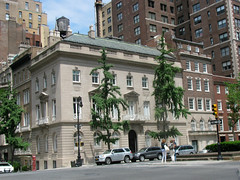
57: The Guatemalan Mission to the U.N. and Consulate General is in a Beaux Arts landmark built in 1911 as the Adelaide Douglas House (1911). Douglas was J.P. Morgan's longtime mistress, and the house had a special door in the back to allow the banker to slip in discreetly.


W <===             EAST 37TH STREET             ===> E

This intersection is the approximate site of Murray Hill, the mansion where Mary Lindley Murray, the lady of the house, served tea to the British General Howe, giving Revolutionary troops time to make an escape.

West:

Union League Club

Corner (38 E 37th): A Republican club formed by members who quit the Union Club because it refused to expel Confederate sympathizers. Members have included presidents Theodore Roosevelt and Chester A. Arthur, banker J. Pierpont Morgan, editor William Cullen Bryant and cartoonist Thomas Nast. The club takes credit for ousting Boss Tweed, founding the Metropolitan Museum of Art and the American Red Cross, and erecting the Statue of Liberty.

This red brick building, by Benjamin Wystar Morris, was built in 1931, long after the club had lost its political fervor. The AIA Guide calls the clubhouse "effete and bland."

36: In October 1964, mobster Joe Bonanno was kidnapped from in front of this defunct address, then his lawyer's apartment. It happened shortly before Bonanno was scheduled to testify before a grand jury--and while Bonanno was apparently contemplating murdering crime boss Carlo Gambino. He reemerged in a federal courthouse in 1966, saying he had been at his cousin's in upstate New York, and retired to Arizona shortly thereafter.

P
A
R
K

A
V
E
N
U
E

East:

45 (corner): The charming Sheraton Russell Hotel, built 1923, was demolished for a 2007 apartment building designed by Costas Kondylis.

43: This was the address of Evander Berry Wall, an 1890s dandy who was famous for changing his clothes several times a day. He boasted that after the age of 17, he never again tasted water--only champagne.


W <===             EAST 36TH STREET             ===> E

West:

30 (corner): Comedian Jackie Mason has lived at this address. Mason calls himself "politically incorrect"--which is literally true, if you think it's wrong to support ethnic cleansing.


P
A
R
K

A
V
E

East:


NYC - Murray Hill: James Hampden Robb and Cornelia Van Rensselaer Robb House by wallyg, on Flickr

23 (corner): This 1898 Stanford White building, originally an Italian Renaissance private home, built for James Hampden Robb and Cornelia Van Rensselaer Robb, later served as home to the Advertising Club of New York. Now apartments.


W <===             EAST 35TH STREET             ===> E

West:


Interior @ Franchia - 12 Park Avenue by wEnDaLicious, on Flickr

12: Franchia, a Korean teahouse whose name means ''generous.''


10: The Metropolitan Synagogue is in this 1931 apartment building. Busy Arnold, publisher of Will Eisner's Spirit magazine, had an apartment here that was apparently something of a lovenest.


P
A
R
K

A
V
E

East:


7 (corner): This address for a short while used to be 1 Park Avenue, when Park began, logically enough, at 34th Street. When the City Council moved the start to 32nd Street, the widow who lived here unsuccessfully sued to keep her prestigious number.


W <===             EAST 34TH STREET             ===> E

West:

The Vanderbilt

Vanderbilt Apartments by hamish_, on Flickr

4 (block): From its 1913 completion until it was converted to apartments in 1965, this was the Vanderbilt Hotel, one of the city's most fashionable in the early 20th Century. Singer Enrico Caruso lived here in 1920 and 1921, his last U.S. home.

Underneath this building is Wolfgang's Steakhouse, run by the Wolfgang Zwiener, who was the legendary headwaiter at Peter Luger's for 40 years (though he got his start at Luchow's). The space, recently called Vanderbilt Station, was famous as the Della Robbia Bar, aka The Crypt. The vaulted Gaustavino ceiling is the big claim to fame. The rumor that this used to be Commodore Vanderbilt's secret private subway station seems not to be true.


33RD STREET SUBWAY: 6 to 28th Street NYC - 33rd Street Subway Station by wallyg, on Flickr

The station is here rather than the more obvious 34th Street because Park Avenue slopes upwards from 33rd to 34th to accommodate the auto tunnel.


P
A
R
K

A
V
E
N
U
E

East:

Norman Thomas High School for Commercial Education

NYC - Murray Hill: 3 Park Avenue by wallyg, on Flickr

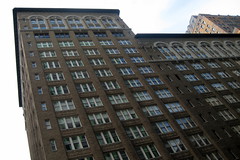
3 (block): Above this school, named for New York's six-time Socialist candidate for president, is a 42-story red-brick office tower, set at a 45 degree angle to the Manhattan grid, designed by Shreve, Lamb & Harmon. Air America Radio, the liberal talkshow network, was originally based here. NYC - Murray Hill: Obelisk to Peace by wallyg, on Flickr

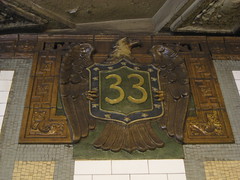
In front of the building is an Obelisk to Peace, by Irving Marantz. There's also a plaque remaining from the former occupant of this site, the 71st Regiment Armory, built in 1905 (replacing an earlier armory on the spot built 1894). The Armory is also recalled by the eagle motif in the subway station below. The 71st Regiment of the New York State Guard had its origin in the American Rifles, a militia affiliated with the anti-immigrant Know Nothing Party. In 1857, the unit intervened in the 6th Ward gang riots, killing the leader of the Dead Rabbits. In the Civil War, it fought at the First Battle of Bull Run and at Gettysburg, among other engagements. In the Spanish-American War, it fought alongside the Rough Riders at the Battle of San Juan Hill.

33RD STREET SUBWAY: 6 to 42nd Street/Grand Central. Eagle 33 by ShellyS, on Flickr

Richard Widmark gets out here in Pickup on South Street to go to the library--he would have saved himself some walking if he had stayed on for another stop.


W <===             EAST 33RD STREET             ===> E
Tunnel to East 46th Street.

This was the southern edge of the Murray Hill farm.

West:

2 Park Avenue by edenpictures, on Flickr

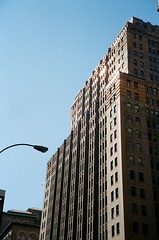
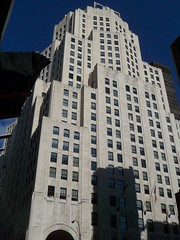
2 (block): Lewis Mumford called this 1927 Art Deco skyscraper by Eli Jacques Kahn "the boldest and clearest note among all our recent achievements in skyscraper architecture." Kahn had an office here, where Ayn Rand worked as a typist while researching The Fountainhead. 2 Park Avenue (Detail) by edenpictures, on Flickr

Built on the site of the fashionable Park Avenue Hotel, which was originally constructed by retail tycoon A.T. Stewart as an ultra-strict Woman's Home.

Houses the bistro/ fromagerie/wine bar Artisinal--great if you love cheese, apparently, but expensive. Inside is Newsday's Manhattan bureau as well as the offices of the Sporting News.

P
A
R
K

A
V
E
N
U
E

East:

1 (block): This 19-story building was designed in 1926 by York & Sawyer, who did the Bowery Savings Bank on 42nd Street and Broadway's Greenwich Savings Bank. The publisher Henry Holt used to have its offices here.

When steam locomotives were banned below 42nd Street in 1858, the horses that pulled the trains from there to the depot at 27th Street were stabled here. Eventually the railroad built Grand Central Terminal at 42nd Street to avoid the bother.


W <===             EAST 32ND STREET             ===> E
Division of Park and Park Avenue South.

West:

NYC - Rose Hill: Schwarzenbach Buildings South by wallyg, on Flickr

470 (corner): Canaan Variety Food Cafe, Straight From the Crate and Workbench Furniture are in the Schwarzenbach Buildings--named for Schwarzenbach Looms, makers of Darbrook Silks. NYC - Rose Hill: Schwarzenbach Buildings South - Silk Clock by wallyg, on Flickr

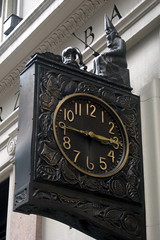
Check out the charming clock on the Park Avenue side--it's surrounded by bas relief leaves, caterpillars and butterflies, and is topped by a wizard and a blacksmith. The Darbrook Silks mosaic above is pretty cool, too.


P
A
R
K

A
V
E

S

East:

NYC - Rose Hill: 475 Park Avenue South - Triad by wallyg, on Flickr

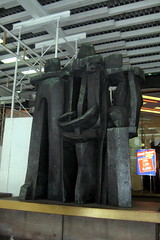
475 (corner): This 35-floor 1969 building by Shreve, Lamb & Harmon was reclad in green in 2006. It's home to the magazine Isaac Asimov's Science Fiction. It has a plaza sculpture, Triad, based on the Picasso painting Three Musicians.


W <===             EAST 31ST STREET             ===> E

West:


450: PS450, lounge, was Arci's Place, cabaret venue


444 (corner): Wild Greens, health food deli; Susie's Kitchen, deli

P
A
R
K

A
V
E

S

East:


455: Alphagraphics; Manhattan Cabinetry

451: Raymond R. Corbett Building, built for the Iron Workers Security Funds and named for a Brooklyn labor leader. The facade is Cor-Ten, intentionally rusted steel.


443: Kalaty Oriental Rugs


W <===             EAST 30TH STREET             ===> E

West:

440 (corner): This 1913 building by Cross & Cross was for many years the address of the publisher John Wiley & Sons. Now Design & Comfort Furniture.

432: Health 4-U, health food. This was the first address of Detective Comics, now known as DC.


420 (corner): Interbank of New York

P
A
R
K

A
V
E

S

East:

441 (corner): John's Deli

439: NYC Computer Service


435: China Express

433: Desmond's Tavern Clarion Hotel Park Avenue by csfocus, on Flickr

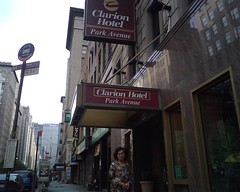
429: Clarion Hotel Park Avenue, pleasant hotel, formerly Howard Johnson Park Avenue South. Former Zeigfield Follies dancer Yvonne Hughes was murdered here in 1950, when it was the Ashland Hotel.

425 (corner): Park Audio


W <===             29TH STREET             ===> E

West:

416: Pinch sells pizza by the inch.

404 (corner): Walter Haefeli was the architect of this 16-story building finished in 1917. Croissant Cafe was on the ground floor.

SUBWAY: 6 to 23rd Street NYC - 28th Street Subway Station by wallyg, on Flickr

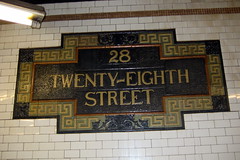
In the film The Taking of Pelham One Two Three, the ransom for the hijacked subway train is delivered to this station. It was also the site of the first recorded real-life subway crime, when a $500 diamond stick-pin was stolen on opening day, October 27, 1904.

P
A
R
K

A
V
E

S

East:

419 (corner): The Bowker Building, 1927 offices also by Walter Haefeli, are described by the AIA Guide as a "strange multihued, almost phosphorescent, terra-cotta clad building" in an "unknown Islamic Industrial style."


407 (corner): The Ascot, rather generic 26-story apartment building from 1983 (Philip Birnbaum & Assoc., architects)


<===               EAST 28TH STREET               ===>

West:

Corner (400 Park Ave S): For years, there's been talk of replacing the parking lot here with a futuristic building by French architect Christian de Portzamparc-- an asymmetric crystalline structure that would be much more interesting than the usual bland residential high-rise.

386 Park Avenue South by edenpictures, on Flickr

386 (corner): A 20-story building from 1927

P
A
R
K

A
V
E

S

East:

SUBWAY: 6 to 33rd Street


House of Ideas by edenpictures, on Flickr

387 (corner): This building, with the Puerto Rico-based Doral Bank on the ground floor, was the long-time home of Marvel Comics. Now it has the offices of Wine Spectator and Cigar Aficionado magazines, as well as Basic Books.


<===               EAST 27TH STREET               ===>

West:

New York Life Building

New York Life Insurance Company by Mr. T in DC, on Flickr

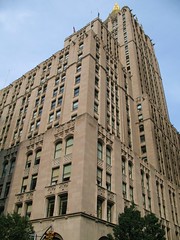
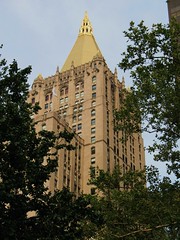
372: A 1928 building by Cass Gilbert, the designer of the Woolworth Tower; the rooftop pyramid is a trademark.

Built on site of New York, New Haven & Hartford Depot, which in 1871 became P.T. Barnum's Hippodrome, later Gilmore's Garden, a roofless three-story arena that the Vanderbilt family turned into the original Madison Square Garden. This was torn down and rebuilt in 1890 to a design by Stanford White--considered his masterwork. Topped by Augustus Saint-Gaudens' Diana (now in the Philadelphia Museum of Art; a smaller copy is at the Met). In 1906, White was shot and killed in the Roof Garden by Harry K. Thaw, jealous husband of White's former mistress Evelyn Nesbit. New York Life Building - Top by Mr. T in DC, on Flickr

What would become the Westminster Kennel Show began here in 1877. Jumbo the elephant was presented by Barnum at the old Garden in 1882; heavyweight champion John L. Sullivan was indicted for "fighting without weapons" after a bout there with the British champ in 1884. In 1895, the rebuilt Garden was the site of the first U.S. cat show, and in 1900 of the first U.S. auto show. In 1913 it hosted the Patterson Strike Pageant, organized by Mabel Dodge and Big Bill Haywood, directed by John Reed with scenery painted by John Sloan. The longest Democratic convention in history was held here in 1924, picking John W. Davis after 17 days and 103 ballots.

In the building's northeast corner, at No. 378, is Houston's, a fancy American restaurant. Also on this block are the Graphic Service Bureau and the Park Avenue Floratique.

P
A
R
K

A
V
E
N
U
E


S
O
U
T
H

East:

Fourth Avenue Building by edenpictures, on Flickr

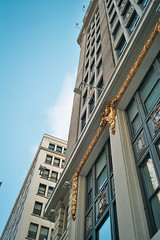
Corner (381 Park Ave S): The Fourth Avenue Building--dating back to 1910, before Park Avenue South was renamed. Impressive gilding. Primehouse, steaks, was a fratty sports bar called the Park Avenue Country Club.

377: The Towanda Building houses the Park Avenue Bistro, formerly Lite Delights Diplomat parking only by Digiart2001, on Flickr

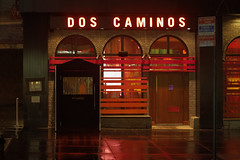
373: Dos Caminos features a huge selection of tequila--perhaps the largest in New York.


IMG_4055_Giraffe, on Flickr

365 (corner): Hotel Giraffe, named for the building's slender form; includes the restaurant Barna, owned by the Dorrian family, whose bars have a history of involvement with notorious murders. The name reminds me of the Irish folk song "Home by Barna" (or "Bearna")--a creepy association considering the young women who have failed to make it home from the Dorrian's establishments. Formerly Chinoiserie.


<===               EAST 26TH STREET               ===>

This intersection is dubbed Herman Melville Square, because the author lived just to the east.

West:

360: Lerner Building

350: This four-story holdout houses the Taza Cafe & Cafe. Provident Loan Society by edenpictures, on Flickr

346: The Provident Loan Society has got to be one of the fanciest pawnshops in the world, with a main office designed in 1909 by Renwick, Aspinwall & Tucker. The Society is a non-profit created in 1893 by leading financiers like J.P. Morgan and Cornelius Vanderbilt to provide an alternative to unscrupulous pawnbrokers.

P
A
R
K

A
V
E

S

East:

IMG_1808.JPG by occam, on Flickr

345-355 (block): A 12-story neo-gothic cube. At No. 345 are the National Law Journal and the New York Law Journal.


Corner (101 E 25th): Megabank branch is on the site of Henry James' last home in the United States, where he lived in 1875 when he began his first novel, Roderick Hudson.


<===               EAST 25TH STREET               ===>

West:

334: George B. Post had a now-demolished building at this address.

Met Life North Building

Met Life Building by A.J. Kandy, on Flickr

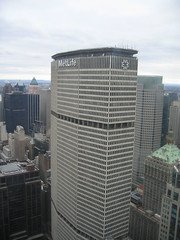
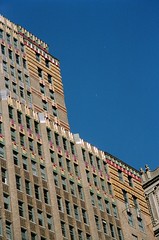
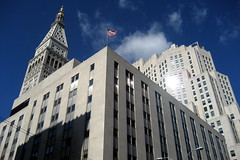
330 (block): Built in 1929 to provide more space for the insurance company next door; 100 stories were planned, but the Great Depression stopped it at 29, leaving it looking something like the Tower of Babel. Expansions took over the entire block by 1950. Considered an Art Deco masterwork with its amazing corner arcades. Now houses Met Life North Entrance by edenpictures, on Flickr Credit Suisse/First Boston; Price Waterhouse is also a tenant.


P
A
R
K

A
V
E

S

East:

Former Tiffany Workshops by edenpictures, on Flickr

333-335: These buildings were the design offices and manufacturing facilities of the Tiffany Glass and Decorating Co. from 1881 to 1905. The corner is vandalized by a Citibank branch.


DSC06985 by Kramchang, on Flickr

329-331: Was Sage


325: Ashby's

323 (corner): Park Deli & Salad Bar


<===               EAST 24TH STREET               ===>

West:

Met Life Building

NYC: Met Life Tower by wallyg, on Flickr

Block: This was the site of the National Academy of Design (1865-99). Replaced by the present structure, an expansion of the Metropolitan Life Building.


SUBWAY: 6 to Union Square

P
A
R
K

A
V
E

S

East:

315 (corner): The Ashland House was a popular hotel here from 1869 until the 1890s. Now a neoclassical building whose facade boasts bas reliefs of Hercules and Minerva.

The Dionysian

NYC 03 by Kramchang, on Flickr

303 (corner): The building with New York Burger, Pax Wholesome Foods was named by Isadora Duncan, who lived and taught dance in this building from 1914-15.


<===               EAST 23RD STREET               ===>

On September 15, 1776, Hessians captured 300 Revolutionary soldiers here during the Battle of Kips Bay.

West:

Kenny Building by edenpictures, on Flickr

304 (corner): The Kenny Building's first 11 stories were completed in 1904, an Italian Renaissance design by Clinton & Russell. A penthouse--a single studio the height of two stories--was added in 1916 for artist Jules Guerin, who painted murals for the Lincoln Memorial here. An adjacent penthouse was added in 1925 by the building's then-owner Bill Kenny for his friend, Gov. Al Smith, to use as a political clubhouse. Known as the Tiger Room (for the "Tammany Tigers"), it was decorated in tiger skins and featured the likes of Al Jolson and Will Rogers as entertainment.

The modeling firm IMG, which represents the likes of Heidi Klum and Gisele Bundchen, now has penthouse offices here. Bath & Body Works on the ground floor.

300 (corner): The Mills & Gibb Building, a 15-story building from 1910 designed by Starrett & Van Vleck for the Mills and Gibb linen store. Note waterbaby carvings. Built on the site of the 4th Avenue Presbyterian Church. Wilhelmina, a modeling firm founded in 1967 by model Wilhelmina Cooper, is based here.

P
A
R
K

A
V
E

S
O
U
T
H

East:

295: The Park 23 was built in 1892 as the offices of the New York Society for the Prevention of Cruelty to Children, designed by Renwick, Aspinwall & Renwick. Note children, infinity-shaped wreaths near top. Converted to apartments in 1982, the structure houses Tossed, fancy salads, and Blue Pink Accessories.


United Charities Building

United Charities Building by edenpictures, on Flickr

287 (corner): This building was built in 1891 to an R.H. Robertson design and had three stories added in 1897. The Provident Loan Society was launched here in 1894, and the NAACP was founded here on May 31, 1909.


<===               EAST 22ND STREET               ===>

West:

Bank for Savings by edenpictures, on Flickr

276-278 (corner): Gramercy Place was the 1894 Bank for Savings (as the stone still notes), saved from demolition in 1987 by the placement of a high-rise apartment on top. Associated Supermarkets on the ground-floor corner.


270: Emma's Dilemma, deli, used to be called My Cousin Vinny; Dina Magazines has a great selection. At the corner is a showroom for the German kitchen fixture company Poggenpohl.

P
A
R
K

A
V
E

S
O
U
T
H

East:

Protestant Welfare Agencies Building

NYC - Church Missions House by wallyg, on Flickr

281: This lovely 1894 building was originally the (Episcopal) Church Missions House. Note frieze above the entrance depicting St. Augustine preaching to the Saxons, and Bishop Seabury preaching to the Indians-- we were heathens once too, is the message.


Calvary Church

NYC - Cavalry Episcopal Church by wallyg, on Flickr

273: Designed by James Renwick Jr. in 1846; diarist George Templeton Strong called it "a miracle of ugliness." It was the Roosevelt family's church (including Teddy and Eleanor). Rev. Edward Washburn, rector here from 1865-81, was the model for Dr. Ashmore in Edith Wharton's The Age of Innocence. Bill W., founder of Alcoholics Anonymous, got many of the ideas behind the 12 Steps from Samuel Shoemaker, rector here in the 1930s.


<===               EAST 21ST STREET               ===>

West:

260: This building, which houses the United Federation of Teachers, added four stories c. 2006 in the same neo-Gothic style--proving that they can build them pretty much like they used to.


P
A
R
K

A
V
E

S

East:

Gramercy Park Building by edenpictures, on Flickr

257 (corner): Gramercy Park Building is a 20-story Warren & Wetmore design from 1913. Note fancy entrances, shell and urn motifs.

251 (corner): Carved heads overlook arches on top three floors.


<===               EAST 20TH STREET               ===>

West:

250: Barbounia, fancy Mediterranean, was Patria, pricey Nuevo Latino. The building is a 1911 Rouse & Goldstone design.


240 Park Avenue South by edenpictures, on Flickr

240 (corner): 2forty, a 2007 residential development by Gwathmey & Siegel, could look a lot worse. It replaced some of the last small-scale buildings on Park Avenue South, including a charming four-story tenement with a pagoda-like cornice that housed Via Emilia, formerly Trattoria I Pagliaci. 240 Park Avenue South (Detail) by edenpictures, on Flickr

P
A
R
K

A
V
E

S
O
U
T
H

East:

IMG_2050 by Lawrence Sinclair, on Flickr

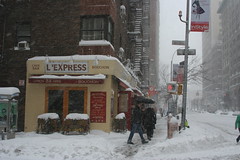
249 (corner): L'Express, 24-hour French bistro.


Sushi Samba by edenpictures, on Flickr

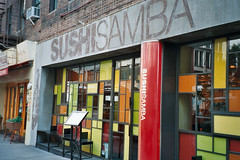
243: Multi-colored restaurant is trendy Sushi Samba

Big Daddy's Diner by emsef, on Flickr

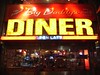
239: The Original Big Daddy's Diner, pan-nostalgic eatery opened in 2005, was Chango, Mexican. Azuki Sushi is at the same address. The building, featuring lions' heads holding wreaths on the top floor, is by Frederick C. Zobel and dates to 1912. City Crab by Steve and Sara, on Flickr

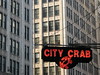
235 (corner): City Crab & Seafood Company, bi-level restaurant opened 1993


<===               EAST 19TH STREET               ===>

West:

Parker Building

230 (corner): Some of the first radio broadcasts originated here, transmitted by Lee De Forest, radio pioneer. Building, which dates to 1895, was also the American Lithographic Co. The Lemon, good date restaurant, used to be here.

A gated archway here leads to a private courtyard.


222 (corner): Was Alkit Pro Camera, est. 1934

P
A
R
K

A
V
E

S

East:

Gold Ring by Finstr, on Flickr

233 (corner): Angelo & Maxie's, named for the place where the "daffydills" entertain in the song "Lullaby of Broadway," is the flagship of a newish steakhouse chain. On this site there used to be a cycloramic painting called The Falls of Niagara--50 feet high and 400 feet in circumference. Earlier it had been a painting of the Battle of Gettysburg. The current structure, an attractive red brick office building, was apparently built in connection with the American Woolen Building next door. The Port Authority moved offices here after September 11. American Woolen Building by edenpictures, on Flickr

225 (corner): The American Woolen Building is a 1909 structure designed by R.H. Robertson for the American Woolen Company; note ram heads. Now home to the magazine Institutional Investor. Wildwood BBQ is on the ground floor, in the space that used to be Barca 18 and Park Avalon. The rooftop was used in Spider-Man 2.


<===               EAST 18TH STREET               ===>

West:

haru by Ralph Hockens, on Flickr

220 (corner): Haru, Japanese, was Choice, American; earlier Nong and Aleutia-- four restaurants since the Songlines started in 2001. In the Bradley Building, an attractive brick-and-limestone structure with nine floors, built c. 1900.


Everett Building

Everett Building (Detail) by edenpictures, on Flickr

200 (corner): Built in 1908 to a Goldwin Starrett & Van Vleck design, this skyscraper's functionalist design was a forerunner of things to come. Union Square Magazine Shop has many foreign mags; Union Bar & Lounge is a stylish yuppie cocktail lounge; Rothman's clothing store is in a former Chase bank branch, selling suits in the basement vault. Everett Building by edenpictures, on Flickr

Built on the site of the Everett Hotel, a popular bunk for entertainers, named for orator Edward Everett, who gave the two-hour speech at Gettysburg that was immediately forgotten. On November 7, 1876, it threw a victory party for Democratic presidential candidate Samuel Tilden--who had his victory stolen by Republican Rutherford B. Hayes.

P
A
R
K

A
V
E
N
U
E

S
O
U
T
H

East:

215 (corner): Site of the Clarendon Hotel, built 1846, designed by James Renwick and financed by William B. Astor. Peter Cooper and Cyrus Field met here in 1854 with other investors to raise money for the trans-Atlantic telegraph cable. The first member of the Russian royal family to visit the United States, Grand Duke Alexis, stayed here in 1871 on his way West to hunt bison. Composer Anton Dvorak stayed here while his house on 17th Street was being prepared. The hip-hop magazine The Source has its offices in the present building, an impressive 1914 structure by Maynicke & Franke. This Was Max's Kansas City by edenpictures, on Flickr

213: Was Max's Kansas City, once the coolest rock club in NYC--and perhaps the world. The Velvet Underground and New York Dolls played there regularly; it was a hang-out for Andy Warhol's crowd. David Bowie met Iggy Pop there; Debbie Harry was a waitress. For a time Patti Smith and Robert Mapplethorpe used to sit on the curb outside because they weren't considered cool enough to be let in. Now a sushi joint.