12th Ave | 11th Ave | 10th Ave |
9th Ave | 8th Ave | 7th Ave |
6th Ave |
Broadway | 5th Ave |
Madison | Park Ave S | Lexington Ave | 3rd Ave |
2nd Ave | 1st Ave | FDR Drive
Pier 66

Most of this pier is actually a railroad barge
permanently docked here, known as
Pier 66 Maritime. It was used
by the Lackawanna railroad to carry train cars across the Hudson
from New Jersey to New York City (where they would be loaded onto the High Line);
there's a Lackawanna caboose onboard today
as a reminder of the barge's former function.
Moored alongside it are two vintage boats: the fireboat John J Harvey,
built in 1931 and retired in 1994, now serving as the Pier 66 Maritime Bar & Grill,
and the lightship Frying Pan, which warned sailors away from the Frying Pan
Shoals off the coast of North Carolina from 1930–65. The Frying Pan
actually spent three years underwater before being raised, repaired and
given to New York City in 1989.
Pier 66A: Kayaking lessons are given
here by
Downtown Boathouse.
|
S <===
12TH AVENUE
===> N
|
South:
U.S. Postal Service Vehicle Maintenance Facility
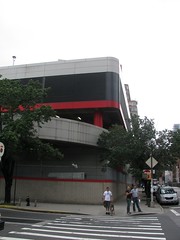
Corner (231 11th Ave): Completed in 1913 as a terminal warehouse for the Baltimore & Ohio Railroad, this nine-story neo-classical structure is said to be the first building to use a flat slab construction technique to eliminate interior beams.
Now mostly occupied by
the co-working company WeWork, but the non-profit art bookstore Printed Matter Inc.
is on the ground floor.
|
|
|
North:

601 (block): Nine miles of strip windows surround this 19-story, block-filling former factory-warehouse,
now lofts; the AIA Guide calls it a
"landmark of modern architecture" since its construction in 1931.
The south entrance features offices for Martha Stewart
Living Omnimedia, the headquarters of clothing brand Club Monaco and
several photography studios. ICE has its New York field office
for "homeland security investigations" here.
|
|
South:
534: Mitchell Innes & Nash gallery; was Gorney Bravin + Lee gallery
530: Was John Connelly Presents, a small,
innovative gallery.
528: Galerie Lelong also
has galleries in Paris and Zurich.
526: West Chelsea Arts Building features a number of art galleries, including
Morgan Lehman, First Street and BravinLee Programs.
From 1979–85, this was Funhouse, an electro/break-dancing
club; New Order's video "Confusion" was filmed here.
524: Paula Cooper Gallery
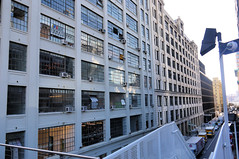
518: Was the Wolff Book Bindery, one of the largest book manu- facturing plants.
An early example of reinforced concrete construction, a technique that allowed for
more open floor plans with fewer supporting walls or pillars.
Earlier on the site were the
Cornell Iron Works, destroyed by fire on June 1, 1893.
510: Alexander Grey
508: A later expansion of the Wolff operation. Now houses galleries like
Greene Naftali and Rogue Space: Chelsea.

Bridging the street here is a disused elevated railroad that was used to transport
freight along the Westside waterfront, replacing the street-level tracks at 10th and 11th avenues that earned those roads the nickname "Death Avenue." Built in 1929 at a cost of $150 million
(more than $2 billion in today's dollars), it originally
stretched from 35th Street to St. John's Park Terminal,
now the Holland Tunnel rotary.
Partially torn down in
1960 and abandoned in 1980, it now stretches from Gansevoort almost
to 34th—mostly running mid-block, so built to avoid
dominating an avenue with an
elevated platform. In its abandonment, the High Line
became something of a natural wonder, overgrown with
weeds and even trees, accessible only to those who risked
trespassing on CSX Railroad property.
In 2009, it was
opened to the public as New York City's newest park; it truly
transforms its neighborhood and hence the city. This section of the park was opened to visitors in 2011.
There is a staircase here connecting the High Line and the street.
Corner (259 10th Ave): Was the RC Williams Warehouse, built in 1928 to a
Cass Gilbert design. Now houses
Avenues: The World School, a multinational private
school opened in 2012.
|
|
|
North:

Corner (260 11th Ave): A seven-story Italian Renaissance Revival building designed by
Clinton & Russell and completed in 1912. It was built for the famous elevator company,
which while it was based here provided lifts for the Woolworth Tower, Chrysler Building,
Empire State Building and World Trade Center, not to mention the Sears Tower in Chicago.
(Earlier the company had provided an elevator for the Eiffel Tower.)
Otis moved out in 1974. In the late 1970s, the building housed the disco/cabaret/restaurant Les Mouches,
which featured performers like Patti Lupone, Grace Jones, Eartha Kitt and Cab Calloway. In the mid-1980s,
Chippendales was here, featuring scantily clad male dancers.
537: Van Cleef & Arfels, jewelry company based in Paris that
boasts of making pieces for the Duchess of Windsor, Eva Perón and the wife of the Shah;
but also for Grace Kelly and Elizabeth Taylor.
533: James Cohan Chelsea, gallery
531: George Adams Gallery
527: Was Team Gallery
521: Numerous galleries, including Laurence Miller Gallery, Hollis Taggart
515: Friedman Benda, Mary Ryan Gallery
513: Was Claire Oliver Gallery
High Line Park
|
|
|
|
|
An odd intersection with a normally parallel street, which takes a 90-degree
turn in the housing project.
|
|
Corner (281 9th Ave): Chelsea Prep (PS 33), K-5 public school. Formerly also housed PS 138 for
children with special needs.
|
|
South:
Penn South Houses

Stretching from 23rd to 29th streets between 8th and 9th avenues, this 1962 housing co-op was built by the
Ladies Garment Workers Union to provide housing for the Garment District.
350: Manor Community Church; congregation
founded 1855, building from 1907.
Penn South Playground
|
|
|
North:
Penn South Houses
Maverick Theater

Performance space under a supermaket
under a rubber-domed tennis court was home from 2003–17 to the
Upright Citizens Brigade Theater,
a coalition of improv groups that got kicked out of their
old home, a former strip club on West 22nd, because it
was a firetrap. After UCBT moved to Hell's Kitchen,
Improv Asylum, a Boston troupe, moved in.
|
|
South:
260 (corner (320 8th Ave): A 12-story building from 2011. Previously here was
Daniella, an Italian that Zagat thought had some of the best food in Chelsea.
Much earlier on this site was Miner's Theatre, a variety house built in 1881 that burned
down in 1902. Rebuilt in 1903 as a movie house, it was renamed the Eighth Avenue and
then the
Chelsea Theatre; demolished in 1959.

250: Former Wells Fargo building is now
Paddles, "the friendly
S/M club." Also home to
Pandora's Box, another BDSM dungeon. On the ground floor is the West Chelsea Veterinary Hospital;
upstairs is Marcelo Garcia Jiu-Jitsu Academy
242: Was Wessel + O'Connor Gallery (1997–2001)—
moved to DUMBO
236: The Capitol Building, erected in 1925 to a Shampan & Shampan design. On the 8th floor here
is the
Jazz Record Center, which has an incredible inventory of
jazz classics.
226: Was New York Auction Co., a fur dealer.

200 (corner): Chelsea Centro;
apartment building from 2001, designed by Costas Kondylis, has Buy Buy Baby on the ground floor. Built on the site of
Guffanti's, gaslight era Italian restaurant where the New York Times recalled that
"Enrico Caruso sang...to patrons including John
Barrymore, Alfred E. Smith, Diamond Jim Brady, Lillian Russell and John Philip Sousa." Opened in
1892, the restaurant survived into the 1960s.
|
|
|
North:
Corner (322 8th Ave): This building—once the Pennsylvania
Exchange Bank—houses offices of Amnesty International,
Bacon's clipping service, the Chakrasambara Buddhist Center
and the Rotary Club of New York.
255: Abacky, sushi fushion
249: Pars, Persian grill
Chelsea Television Studios

221: Studio where Rachael Ray and Wendy Williams tape their shows.
Ricki Lake Show and
Judge Hatchett. Was Adolph Zukor's Famous Players,
a silent film company that featured Broadway actors in
adaptations of classics; after merging with other film
companies, it became Paramount Studios. 12 Angry Men was shot here in 1957,
BUtterfield 8 in 1960 and
Mel Brooks' The Producers in 1967. It was also used by
such TV shows as the Patty Duke Show and
Inner Sanctum and classic soaps like As the World Turns,
Guiding Light and Search for Tomorrow. More recently
Ricki Lake, Martha Stewart and Tyra Banks have made shows here.

Corner: A state university founded in 1944 to
provide "an MIT for the fashion industries." Designers Calvin Klein, Norma Kamali and Michael Kors
all attend FIT, as did Kors'
Project Runway co-star Nina Garcia and director Joel Schumacher.
The
architecture, by De Young & Moscowitz, looks inspired by Stonehenge.
On this block is the school's Museum of Fashion.
|
|
South:
Lefcourt Clothing Center

Corner (275 7th Ave): This 1929 building originally
housed garment workshops, one of the first lofts built for
that purpose; now houses the garment workers' union UNITE—the
merged ILGWU and ACTWU. Organic Market is on this corner on the ground floor.
160: Was Minnesota Fats billiards supplies
158: Was New York Dance Center,
offering classes in everything from ballroom dancing to Japanese sword-fighting.
156: Chelsea Bicycles
154: Below Co Co Sushi was
Muse Karaoke Studio—nice song selection and really good TVs.
150: Maxine Grand fabrics; Empire Pump & Motor
146: Rock Star Crystals was Revolution Books, bookstore affiliated
with the Revolutionary Communist Party.
144: Lois Hanier, "an inoffensive French Saloon keeper,"
was murdered here on Christmas Eve 1881 by one Michael McGloin.
Inspector Thomas Byrnes' capture of McGloin has been
described
as "one of the finest pieces of detective work ever done in any city."
140: Starbright Floral Design
134: Chelsea Arts Building
132: 26th St Gourmet Deli was Mother West Deli—
in undoubtedly the oldest building on the block. Recently
demolished, unfortunately.
130: Chelsea Bicycle; A1 Color Lab
122: From 1995–2007, this was Neutral Ground, the prime gathering place for players of
collectible card games and roleplaying games
like D&D.
The building is the Dezer Building; downstairs is The Ainsworth Chelsea, which is a local mini-chain.
114: Buffalo Exchange, vintage clothing, was Metropolitan Fencing, sword-fighting school—
complete with Touche Cafe.
110:
La Mano Pottery, classes;
The Fabscrap Shop, recycled fabric. Was New York Wood Flooring Corp showroom.
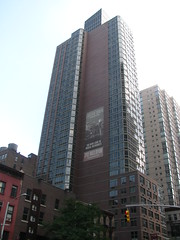
100 (corner): Chelsea Tower— slightly sinister 33-story highrise, completed 2003.
|
|
|
North:
177 (corner): Building that was S&W (Summer & Winter?)
clothing has attractive brick arches.
165: B&B Restaurant, cozy West African buffet; I get lunch here once or twice a month. Was S&W Ladies Wear—remnant of the long-running
store on the corner.
155: Sculpture House Casting
153: Zucker's Fine Gifts
147: KDM Hardware
143:
Burgundy Wine Company holds nightly tastings.
137: Helen Mills Event Space and Theater
135: Formerly the studio of
Mercer Media (formerly on Mercer Street), where the
CounterSpin radio show is produced. During
the blackout of August 28, 2003, I walked up 12 flights
of pitch-black stairs here to escort my pregnant wife down.
127: Black Door Bar was the site of the first-ever
reunion of interns from The Nation magazine,
October 3, 2002.
125: Holiday Inn Manhattan 6th Avenue/Chelsea, 24-story hotel built 2006.
119: Was Marjorie's Catering; On the Move Events. Torn down for the hotel.
117: Was Avenue A Cards, art postcards and posters—transplanted from
St Marks Place, I believe.
111: Montauk Credit Union
107: Digital Cleaners is a dry cleaner; not sure what's digital about it.

105: Was Sewtech Sewing Machine Co., a survivor of
the block's Garment District roots into the 21st century. From
here to 6th Avenue is one building, six stories built 1904.
99: Was Time Sewing Machine Co., another survivor
Corner (775 6th Ave): Was Koffeecake Corner, cafe; before that
FAS: Fifth Avenue Style, cheap clothing.
|
|
South:

Block: This 35-story apartment building in 2007 replaced a parking lot
with big weekend flea market—featured
in the children's book My New York.
"Kristen," the professional escort whose assignation
with Gov. Elliot Spitzer led to his
resignation, lived here at the time the
scandal broke.
38: Flatiron Hall, beer hall opened in 2013. Its
website claims
that its 25-foot bar "from the Commodore Hotel in downtown Manhattan, from 1870." Maybe there's
another Commodore Hotel I haven't heard of, but the famous one (now the Grand Hyatt) was built on 42nd Street
in 1919. This space used to be The Block USA Sportswear.
36: Hanjan, modern Korean pub food, opened 2012. Was Sirtaj, Indian
take-out; I ate a great deal of vegetable biryani from here.
30: Hill Country Barbecue Market was Markus Antique Gallery, including the
International Antiques Center.
28: Was the
Hotel Caledonia, where writer
O. Henry lived (1906-07)
before moving to the Chelsea Hotel; he kept a
room here for writing. He collapsed here June 3, 1910, and died two days later.
26: The Lambs Club, an actors'
society organized in 1874, had its first permanent offices
at this address. Among its many famous members are counted
Fred Astaire, Gene Autry, several Barrymores, Irving Berlin, George M. Cohan,
Cecil B. DeMille, Douglas Fairbanks, William S. Hart, Victor Herbert, Bert Lahr,
Alan J. Lerner, Frederick Loewe, Ring Lardner, Will Rogers and John Philip Sousa.
By 1897, the brownstone had become the first
clubhouse of the Yale Club. It's now a parking lot.
22–24: Crossroads Trading was Metro Line was Regal Wear. Twelve-story building
from 1910.
20: A well-preserved classic brownstone (sans stoop).
16: Built in 1866 as Trinity Chapel's Clergy House;
now offices for St. Sava.
St. Sava Serbian Orthodox Cathedral

15: Back entrance. Before 1943, this was the
Epicopalian Trinity Chapel, an satellite of downtown's
Trinity Church, built 1850–55 to a
Richard
Upjohn plan. (He also did downtown's Trinity
Church and what is now The Limelight.) Diarist
George Templeton Strong was a member of
the congregation; novelist
Edith Wharton was
(unhappily) married here in 1885.
After being sold to the Orthodox, the church was renamed for
the first archbishop of Serbia. The exiled King Peter II
of Yugoslavia attended mass here in the 1940s.

The building suffered a devastating fire on May 1, 2016, caused by
improperly extinguished Easter candles; only the walls of the church were left standing. Originally the building was thought
to be unsalvageable, but parishioners resolved to rebuild; by 2019, a roof had been put back on the structure.
St. James Building
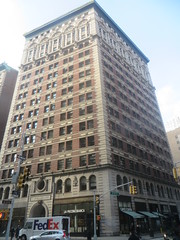
Corner (1133 Broadway): This ornate 1897 office building,
surmounted by Ionic pillars, provided
offices for architects, including its designer, Bruce Price, and the
Flatiron's Daniel Burnham. Future Israeli prime minister Golda Meir worked here for the Pioneer Women's
Organization for Palestine (1932–34).
From 1965 to 1968, this was
the base of the Mattachine Society, the leading pre-Stonewall gay
rights group. Back to Africa Imports and La Pecora Bianca ("The White Sheep"), Italian cafe, are on the
ground floor on the 26th Street side.
Built on the site of the fashionable St James Hotel, which Confederate saboteurs tried to burn down on
November 25, 1864.
|
|
|
North:
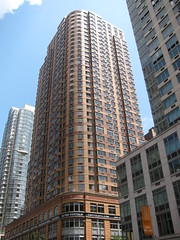
55 (corner): The orangey brick Capitol at Chelsea was built on the site of The Racquet Club, the first sports club in NYC.
Later the University Athletic Club. The building, the most interesting on this stretch of 6th Avenue, was landmarked, but money spoke louder than architecture. The Antique Cafe on the ground floor used to be a block away on 25th Street.
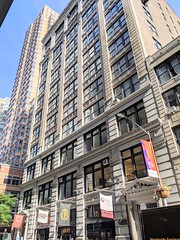
37: The Princess Marion Kiamie building
houses Grey sports bar; Hog Pit NYC, barbecue joint founded in
1995 in the Meatpacking District; and Flatiron Room, whiskey bar opened in 2012. Upstairs is
Stepping Out Studios, ballroom dance school opened in 1985.
Formerly on the ground floor here were Satalla, the "temple of world music,"
Gstaad, Swiss-themed lounge,
and Kavehaz, a jazz gallery cafe bar restaurant. (Marion Kiamie
was apparently the matriarch of a real-estate family, and not an actual princess.)
From 1975–79, the 12th floor here was known as
The Studio, an artists' commune launched by comics creators
Barry Windsor-Smith (Conan,
Jeff Jones (Idyls),
Michael William Kaluta (The Shadow) and
Bernie Wrightson (Swamp Thing).
35: Sportstar USA
33: Mite Inc Imports Exports & Wholesale
31: B.W. Sportswear
29: The Von-Hoffman building, with fancy pillars, houses the Latin American Restaurant.
25: A handsome red brick building, defaced
on the lowest two floors, houses The Source Clothing
Company, affiliated with the hip-hop magazine.
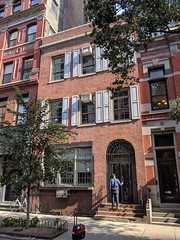
23: For a time this was the headquarters
of the Communist Party USA; the offices were bombed
a half-dozen times from 1964 to 1972, with a
particularly powerful blast in 1966 destroying
the stained glass in St. Sava's apse.
21:
Writers House literary agency—
which represents such writers as
Nora Roberts, Ken Follett,
Erica Jong and
Neil Gaiman—
is in the former HQ of the Astor family real estate empire.
A cute little old house.
19: A-1 Hats, wholesaler
15-17: Pro-Land Inc. wholesale sportswear.
Upstairs is
The Breathing Project, nonprofit yoga space.
13: Thunderbird Sportswear, hat and cap wholesaler

Corner (1141 Broadway): Flatiron Hotel opened in 2011, run by Toshi Chan, an
actor who became a pirate hotelier before going legit.
Toshi's Penthouse was the rooftop bar; there used to be a live music venue,
Toshi's Living Room, on the ground floor. But I think the future of the
whole place is in doubt.
Before the hotel Zena Coffee Shop, Fortuna Jewelry were here.
|
|
South:
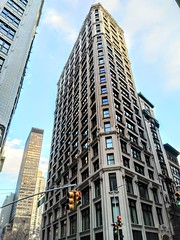
Block (212 5th Ave): The 5th Avenue corner
was the site of Dodworth Studios, where Teddy Roosevelt
took dance lessons as a boy. In 1876
Delmonico's, at the time the most fashionable
restaurant in New York, moved here. This location
was the birthplace of Lobster Newberg and Eggs
Benedict. The women's
organization Sorosis met in an upstairs room. When
Delmonico's moved uptown in 1899, it became Cafe
Martin, where on June 25, 1906 architect Stanford
White had his last meal before being shot at his
Madison Square Garden.
This 21-story neo-Gothic building, designed by Schwartz & Gross,
went up in 1913; the FX cable channel was here in the 1990s.
In 2019 the three-story penthouse was bought by Amazon CEO Jeff Bezos
(along with two other apartments in the building), despite his
cancellation of plans to build a second Amazon HQ in Queens.
|
|
|
North:

Corner (1146 Broadway): 1140 (corner): Ground floor of the 1915
Lowell Building has The Little Beet (mostly vegetarian), Vin Sur Vingt Wine
Bar on the ground floor. (The wine bar's name is a pun on "vingt sur vingt,"
meaning 20 out of 20—a perfect score.) Arnold Joseph, a bookstore for railroad
fans, used to be upstairs here.
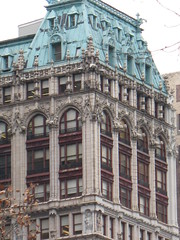
Corner (220 5th Ave): Crystal Clear
Galleries is on the ground floor of the Croisic
Building (1912)—on the site of the Croisic
Hotel, named for Richard de Logerot, Marquis
de Croisic, aristocrat and hotelier. Fancy
gargoyles on the upper floors. The Belgian Beer
Cafe was on the ground floor from 2014–19.
|
|
South:
Madison Square Park

The 1807 plan set aside 240 acres in this
vicinity as The Parade, to be used for military training.
In that same year, the U.S. Arsenal was
built here to defend the strategic
intersection of the Bloomingdale Road
(now Broadway) and the Eastern Post Road.
By 1814, when the park was named Madison Square
after the then-current president, it had been reduced to 90 acres.
In 1847, when Madison Square Park was opened, less than seven acres remained.
The park, which was laid out in its current form in 1870, was the center of New York society in the 1860s and '70s. "The vicinity of Madison Square
is the brightest, prettiest and liveliest portion of the great city," James McCabe wrote in 1872.
In July 1901, an attempt to turn seating in the
park into a for-profit concession sparked rioting.
The park provides a setting for O. Henry short stories like
"The Cop and the Anthem" and "The Sparrows in Madison Square").
The U.S. Arsenal was converted by
1824 to the House of Refuge of the
Society for the Reformation of
Juvenile Delinquents—the first
such institution in the country.
Admiral Farragut Memorial

1881 commemoration of David Glasgow Farragut, Civil War fleet commander, best remembered for his "damn the
torpedoes, full speed ahead" line. Sculpture by Augustus Saint-Gaudens, pedestal by Stanford White. Considered to be the
first use of Art Nouveau in U.S.
Chester Arthur Statue
 Commemorates the 21st president, who lived and took his oath of
office nearby on Lexington Avenue on September 19, 1881, after President James Garfield was
assassinated. As a young lawyer, Arthur led an 1854 case that desegregated streetcars in
New York City, and assisted on another case that successfully argued that all enslaved people
were automatically freed in New York state—though as the ruling came in 1860, the victory was
soon moot.
Commemorates the 21st president, who lived and took his oath of
office nearby on Lexington Avenue on September 19, 1881, after President James Garfield was
assassinated. As a young lawyer, Arthur led an 1854 case that desegregated streetcars in
New York City, and assisted on another case that successfully argued that all enslaved people
were automatically freed in New York state—though as the ruling came in 1860, the victory was
soon moot.
|
|
|
North:
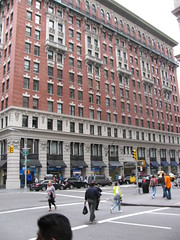
Corner (225 5th Ave):
Handsome red-brick building was built in 1906 as the Brunswick
Hotel, noted as the home of the Coaching Club,
which held carriage parades up 5th Avenue. Waldorf
chef Oscar Tschirky and restaurateur Louis Sherry
got their starts here as bellhops. On July
14, 1880, on the 16th day of a celebrated 40-day
fast, Dr. Henry S. Tanner stopped here and drank
two ounces of water. Later it was the Gift Building, "the
premiere international giftware showplace." On
the ground floor was Cafe Atomico
(1998–2004). Converted into apartments in 2004.
In Willa Cather's My Mortal Enemy,
protagonist Myra Henshawe lives in a brownstone on this
block, in an era when fashionable townhouses lined Madison Square.
11: The National Museum of Mathematics was House International Silver Co.
and other silverware wholesalers. The building was used for
rooftop shots in Spider-Man 2.
15: Madison Square Building houses,
among others, the Vietnamese-American Chamber of Commerce.
This used to be the headquarters of Lionel Trains;
on the second floor there was a huge model train layout
surrounded by display cases of older Lionel train sets.
19: Blackbarn, farm-to-table cuisine in a rustic setting
21: This four-story Georgian-style building was built in 1926 by textile maker Clarence B. Williams. It was the longtime headquarters of Plumbers Local 1. It's now converted to
luxury condos, with just four units, each stretching the whole length of the building to East 27th Street.
(It's a 30-second walk from one end of a unit to the other.)
Chelsea Clinton was among the first to own a unit.

23–25: A stone oak wreath marks the entrance
of the Neptune Building, a 1910 design by Maynicke and Franke. On the ground
floor is Mendez Boxing, a gym.
Formerly the showroom for Hafele, maker of architectural
and furniture fixtures.

Corner (50 Madison): Built in 1896 for the American
Society for the Prevention of Cruelty to Animals. In 2005,
modernized and expanded above the third floor.
|
|
South:
Merchandise Mart

Corner (41 Madison): Forty-two-story black-glass
modernist building from 1974 has showrooms for china, silver, crystal etc.
I used to think of this building as an eyesore, but with glass highrises built on
the south end of Madison Square, it serves as a useful balance.
Built on site of Jerome Mansion (1859–1967),
birthplace of Jennie Jerome, Winston Churchill's mother. Later housed
Manhattan Club, meetingplace for Democrats like
Grover Cleveland, Al Smith, FDR, and birthplace of the Manhattan cocktail. Demolished in
1967 despite being landmarked two years earlier.
From 2004–17, the ground floor was A Voce, fancy Italian; formerly Le 26,
and before that Chazal.
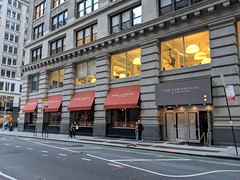
Corner (360 Park Ave S): The Lerner Building, a 20-story office building from 1913,
was home to Reed Elsevier, monopolistic science publisher. On the ground floor is Park Avenue,
a restaurant that changes its decor and menu with the seasons—thus Park Avenue Spring, Park Avenue
Summer, etc. Above it is the Townhouse at Park Avenue, a clubbish annex to the restaurant.
|
|
E
A
S
T
2
6
T
H
S
T
R
E
E
T
|
North:
New York Life Building

Block (372 Park Ave S): A 1928 building by
Cass Gilbert, the designer of the Woolworth Tower;
the rooftop pyramid is a trademark of his.
Built on site of New York, New Haven & Hartford Depot,
which in 1871 became PT Barnum's Hippodrome, later
Gilmore's Garden, which the Vanderbilt family turned
into the original Madison Square Garden.

This was torn down and rebuilt in 1890 to a design by
Stanford White—considered his masterwork. Topped
by Augustus Saint-Gaudens' Diana (now in the Philadelphia
Museum of Art; a smaller copy is at the Met). In 1906, White was
shot and killed in his building's Roof Garden here by
Harry K. Thaw, jealous husband of White's former mistress Evelyn Nesbit.
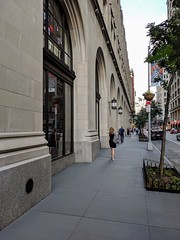
In 1900, the Garden was the site of the first
US auto show. In 1913, it hosted the Patterson
Strike Pageant, organized by Mabel Dodge and Big
Bill Haywood, directed by John Reed with scenery
painted by John Sloan. The longest Democratic
convention in history was held here in 1924, picking
John Davis after 17 days. New York Life tore the Garden
down in 1925 to make room for its office building.
|
|
This intersection is dubbed Herman Melville Square.
|
South:
104 (corner): Office building next to the Armory
has the address of
Herman Melville's home from 1863–91,
where he wrote Billy Budd. National Law Journal
has offices here.
69th Regimental Armory
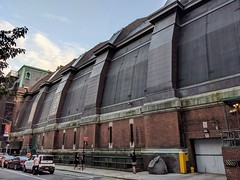
68 (corner): The
"Fighting 69th" of the New York Army
National Guard was
"New York's only official Irish regiment,
according to New York City Landmarks. The
troop fought in the Civil War with heavy casualties,
and took part in both world wars.
This building was the home of
the
Armory Show in 1913, which introduced modern
art to the United States. Organized by the
American Association of Painters and Sculptors,
a group that represented the "Ashcan School" of
social realism, the show brought
widespread attention (and initially ridicule) to
abstract painters like Matisse, Picasso,
Van Gogh and Cezanne. Marcel Duchamp's Nude
Descending a Staircase was singled out for abuse
and parody.
The New York Knicks played some of their home games here from
1946–60. Roller derby was played here in 1948–49, including
the first televised matches.
|
|
E
A
S
T
2
6
T
H
S
T
R
E
E
T
|
North:
Corner (365 Park Ave S):
Hotel Giraffe, tall and slender, includes the restaurant
Bread and Tulips, which takes its name from an Italian romantic comedy
released in 2000. Formerly Barna, before that
Sciuscia, and earlier Chinoiserie.
111: Several amalgamated and modernized
rowhouses?
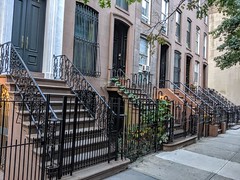
117–127: Row of handsome brown- stones,
with stoops intact.

129 (corner): A 19-story building from 1927.
|
|
South:
Corner (77 Lexington): Cousins Maine Lobster was Paradise Biryani Pointe, and before that
—going back to 1964—Famous Original Ray's, though it was not either one. Also the Tali Dolce, gluten-free bakery,
which was Fava
Mediterranean Grill.
134: Luu's Bagette, Vietnamese sandwiches, was Salon Mexico
138: Global Kids, Baruch College student organization

152: The back entrance of Baruch College's
Newman Library,
built in 1894 as a power station for the cable cars of
the Metropolitan Street Railway Company of New York, and later the Lexington Company.
Converted to a library in 1994 by Davis Brody Bond.

Corner (354 3rd Ave): The Abbey Tavern is an Irish pub
opened in 1964, then updated as Vertigo in 2004, which lasted a decade
before reopening under its old name. In the early 1960s it was Tobin's,
described as having "old-time decor but modern prices."
|
|
|
North:
Corner (81 Lexington): Saravandaas Bhavan, Indian vegetarian with
five A's in its name.
137–139: Hill House
147–149: Amalgamated Industrial and
Toy & Novelty Workers of America Local 223
153 (corner): Little Basil, Thai
|
BROADWAY ALLEY
===> N
A
private lane
said to be Manhattan's last dirt road. It
has one address on it, 8 Broadway Alley.
|
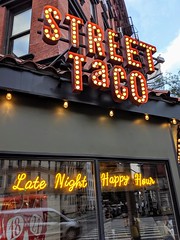
Block (358 3rd Ave): Street Taco was Bamiyan, Afghan
|
|
South:
Corner (355 3rd Ave): Was Innovative Woodwork
206-210: Entrance to a charming inner courtyard.
220: Grubbiness probably helps this modern yet old,
multicolored
apartment house, built in 1963.
226–230: Elaborately detailed apartments, built c. 1920.
232: "The only Old Law tenement left in the entire goddamn zip
code," according to a reader.
238: Liberty Studios is owned by filmmaker
Anthony Lover, who made an Ingmar Bergman parody called
"De Duva" that briefly tricked me into thinking
I could understand Danish.
240:
Holographic Studios, a commercial hologram lab
with a free gallery of 3-D images.
242–244: Old three-story rowhouses

Corner (459 2nd Ave):
Mexico Lindo restaurant opened
in 1972 and is still owned by the same family, who come from Mexico City.
|
|
|
North:
Corner: Sunflower Diner closed in 2018.
203: Bar 263 is above and Thai V Express (formerly City Spice Cafe) below in an
odd two-story tenement building. Was Ollie's Place Pet Supplies/Cat Adoption Center.
205: Another two-story oddball.
207: Abumi Sushi was Tatany seafood takeout was Moo/Shoes vegan footwear.
"And before vegan footwear was... a butcher's shop!" notes a reader.
215: Downtown Doghouse, pet salon, was Anthony's Haircutters, old-school
Sicilian barbers.
217: Tipsy Scoop Parlour, alcohol-spiked ice cream
225: Sibling to No. 220
239: An attractive brick plaza with
a waterfall, provided by the Parc East tower
in order to get a zoning variance. The city
sued the building in 2000 because it had locked a
passageway that was supposed to connect this
mini-park with 27th Street.

Corner (240 E 27th): Parc East apartment tower, 26 stories from 1977.
|
|
South:
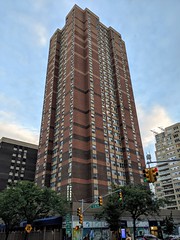
310: Address of the Riverside Rest
Association, which cared for women released
from Blackwell's Island, including "women who are addicted to
alcohol, or victims of the opium habit, or immoral."
330 (corner): Phipps Houses South were built by
the Phipps Houses Group, a nonprofit development
group founded in 1905 by Henry Phipp, a business partner
of Andrew Carnegie. These buildings were part of a
project to provide nearby affordable housing for Bellevue
workers. People who put up money for the project sued the group
in 2002 to force the buildings to become for-profit.
Includes the Acorn School.
334: NYU dorm

Corner (433 1st Ave): NYU building that houses colleges of nursing, dentistry
and engineering. Completed 2015 to a Kohn Pedersen Fox design. Replaced the
NYU School of Medicine's Basic Science Building,
built in 1897 for Bellevue Hospital Medical College.
|
|
|
North:
Phipps Plaza West Apartments
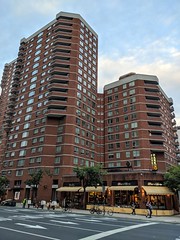
Corner (462 2nd Ave): These buildings were put up in 1976 by the
Phipps Houses Group
as a major part of the South Bellevue Urban Renewal project.
Since 2002, rival lawsuits have sought to take
the project out of the Mitchell-Lama program
or keep the housing nonprofit until 2011.
On the ground floor is Totonno's, the second Manhattan
branch of a beloved Coney Island pizzeria. Used to be Old San Juan Too, Puerto Rican/Argentine.
The Vineyard Theatre, now in the Zeckendorf, used
to be here.
Corner: Bellevue South Park, a small
neighborhood recreation area
|
Public Health Lab

Block (455 1st Ave): houses the
Aaron Diamond AIDS Research Center.
This center played a key role in developing
the combination drug therapy that has
greatly reduced the death rate from HIV in the U.S.
In 1996, Dr. David Ho, the center's director,
was named Time's person of the year.
|
|
|
|
|
North:
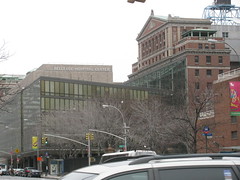
This institution got its start in 1794, when the city needed a site to treat victims of a yellow fever
epidemic far from the city center, they bought the Belle Vue estate of Peter Keteltas, named for its
beautiful view
of the East River. In 1811 additional land nearby was purchased from the Kip family.
Songwriter Stephen Foster, who fatally injured himself in a Bowery flophouse, died here in 1864. Socialist
Congressmember Meyer London died here after being struck by a car in 1926.
People used to refer to the emergency ward as the Eastman Pavilion because gangster Monk Eastman sent
so many people here with his club.
It's most famous for its psychological services; Dr. Norman Jolliffe's study of patients here helped establish the
modern concept of
alcoholism. Santa Claus was sent to Bellevue for observation in
Miracle on 34th Street, and
Ray Milland dried out here in The Lost Weekend. In "For You," Bruce Springsteen sang that "They're waiting for
you at Bellevue/With their oxygen masks."
|
|
Waterside Plaza

 Built on landfill consisting of World War II–era rubble from Bristol, England, this 1974 residential
complex with four oddly angled towers ranging from 31 to 37 stories was designed by Davis, Brody &
Associates. It's the only residential project east of the FDR Drive.
Built on landfill consisting of World War II–era rubble from Bristol, England, this 1974 residential
complex with four oddly angled towers ranging from 31 to 37 stories was designed by Davis, Brody &
Associates. It's the only residential project east of the FDR Drive.
|
|